
The Anatomy of Answer writing- “Practical approach”
23 July 2026
The Anatomy of Answer writing - “Practical approach”
To understand what constitutes a good answer for mains examinations, we have to look into the various stages leading up to the day of examination.
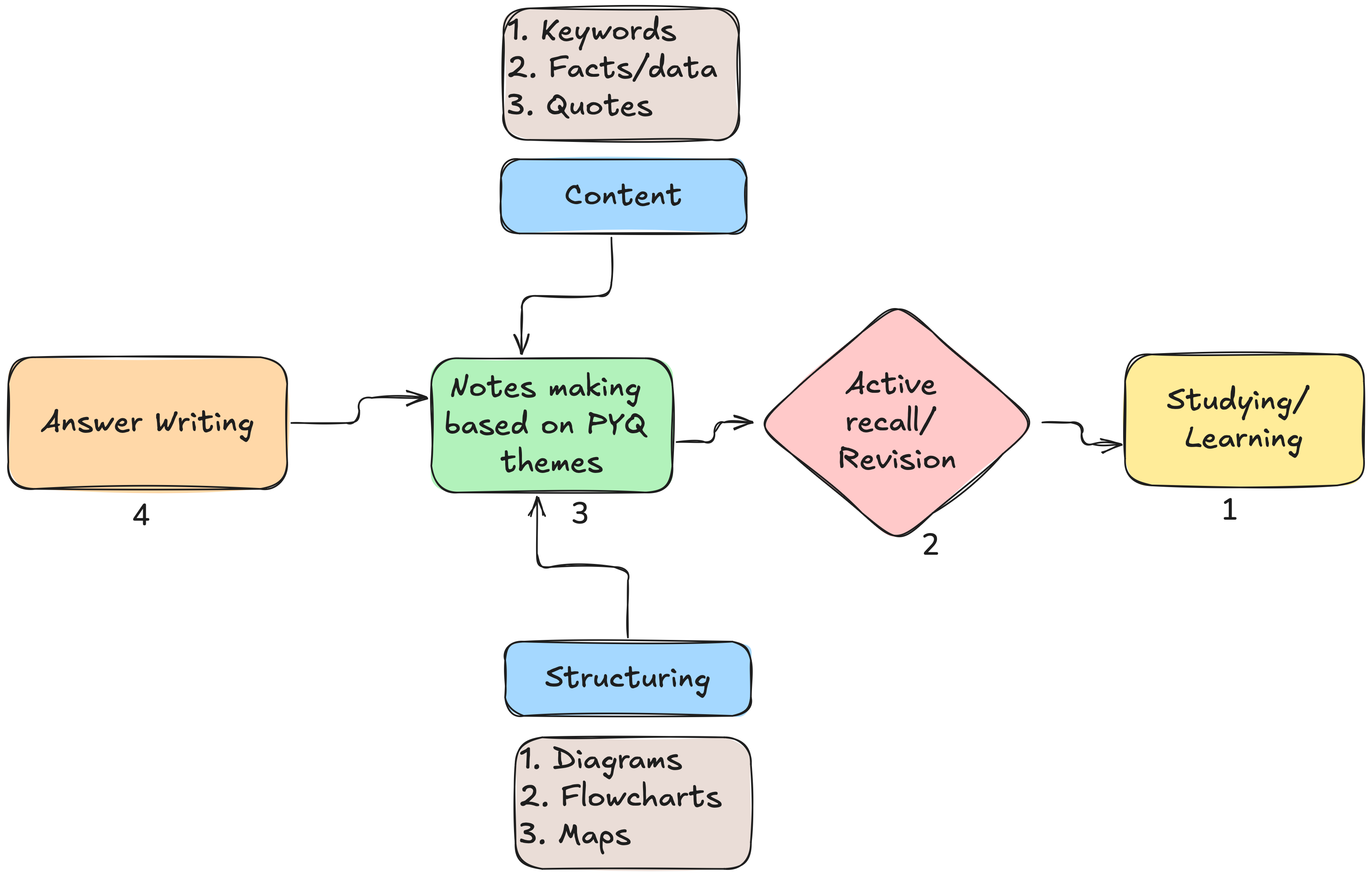
Fig: The above diagram indicates that the art of answer writing depends on mastering the sequence of steps leading up to it.
Two things that stand out for a good answer writing are:
- The ability to recall what has been studied on the day of exam.
- Writing the content such that it is relevant to what has been asked in the question.
Both of these things require practice and need to be approached separately.
1. Recalling what has been studied on the day of the exam
What is essentially a good answer? I would say a good answer is one where you are able to identify the topic/theme from which the question has been asked and are able to replicate at least 70-80% of your notes in the exam.
I have categorized these as follows.
- Learning methodically through frameworks and association.
- Structured note making.
- Deepening neural pathways by actively recalling.
1. Learning methodically through frameworks and association
During this learning process, the agenda is to only understand the core concepts and what are the major topics and subtopics and how these topics are interlinked with each other. Remember to highlight the conceptual ‘key terms’ and not english sentences.
We can use ‘Framework thinking’ which many toppers have suggested for better memorisation. This is basically learning key pointers under important subheadings. Let me take an illustration for this. This also helps in brainstorming and recalling better.
Illustration: Urbanisation in India
One of the general frameworks we use is PESTEL - Political, Economic, Social, Technological, Environmental, Legal.
- Political- Lack of devolution under 74th Constitution amendment Act
- Economic- Lack of funds. (Green bonds, Municipal bonds)
- Social- Health, Education, Migration, Skilling issues
- Technological- Smart city, Metering etc.
- Environmental- Heat island, Urban Flooding, Droughts and other disasters
Interconnected topics can be ‘associated’ with the main topic. Imagine this as a sub-branch and read about other topics with the main branch such that you are able to build other concepts with a base contextual topic.
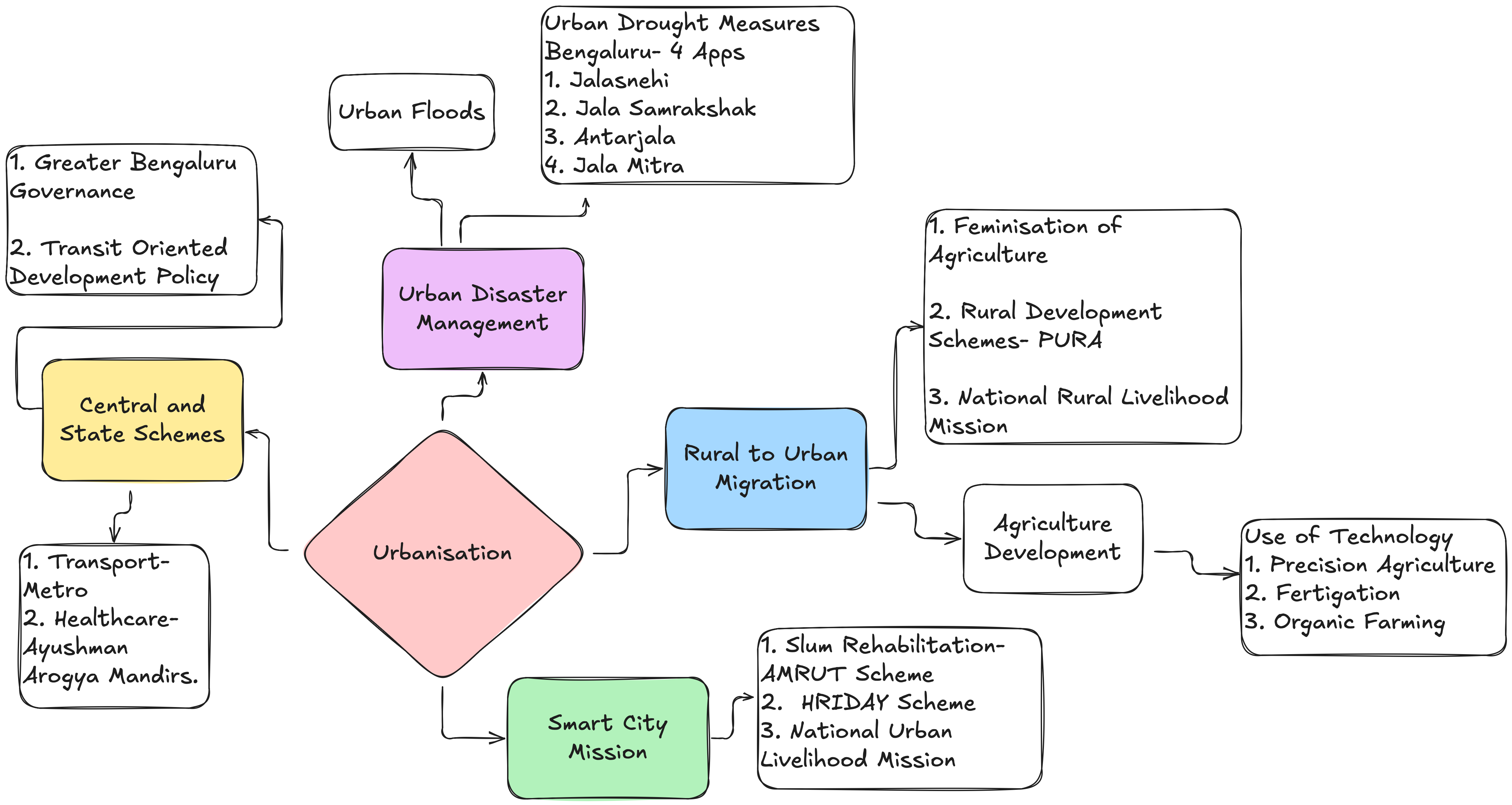
Fig: Branching from main topics for holistic learning.
Note: In the above mindmap, you can observe that while studying urbanisation and its problems, we can study interlinked topics of feminisation of agriculture. Further we can study about farm women development- Mahila kisan Shahsktikaran Pariyojana, Disguised unemployment, NRLM, Women Farmer Producer Organisations (FPO’s), Cooperatives, Krishi Sampada and food processing, Kudumbashree SHG etc.
This networked mapping of what you study can help in easier point generation during exams.
Take a minute here to think of other dimensions that you can add for urbanisation (Hint: Migrants, ghost citizens, gig workers)
The One major mistake that many make during this initial phase of learning is obsession over notes. Notes are supposed to help you replicate content on the exam answer sheet. What you will replicate in the exam depends on the final ‘micro notes’ and not the initial descriptive notes. Hence consolidation and consizing is important. Let us understand this in detail in the next chapter.
2. Structured note making
Take a pause and think about why note making is necessary for mains answer writing?
Please stop reading further and train your brain to think!
In simpler terms, a good mains answer is one that has specific keywords which is relevant to the demand of the question. To be able to recall these keywords in exam, you need to have a ‘consolidated micro notes’ from which you have done multiple revisions.
I have taken an illustration to explain how to arrive at this stage of note making.
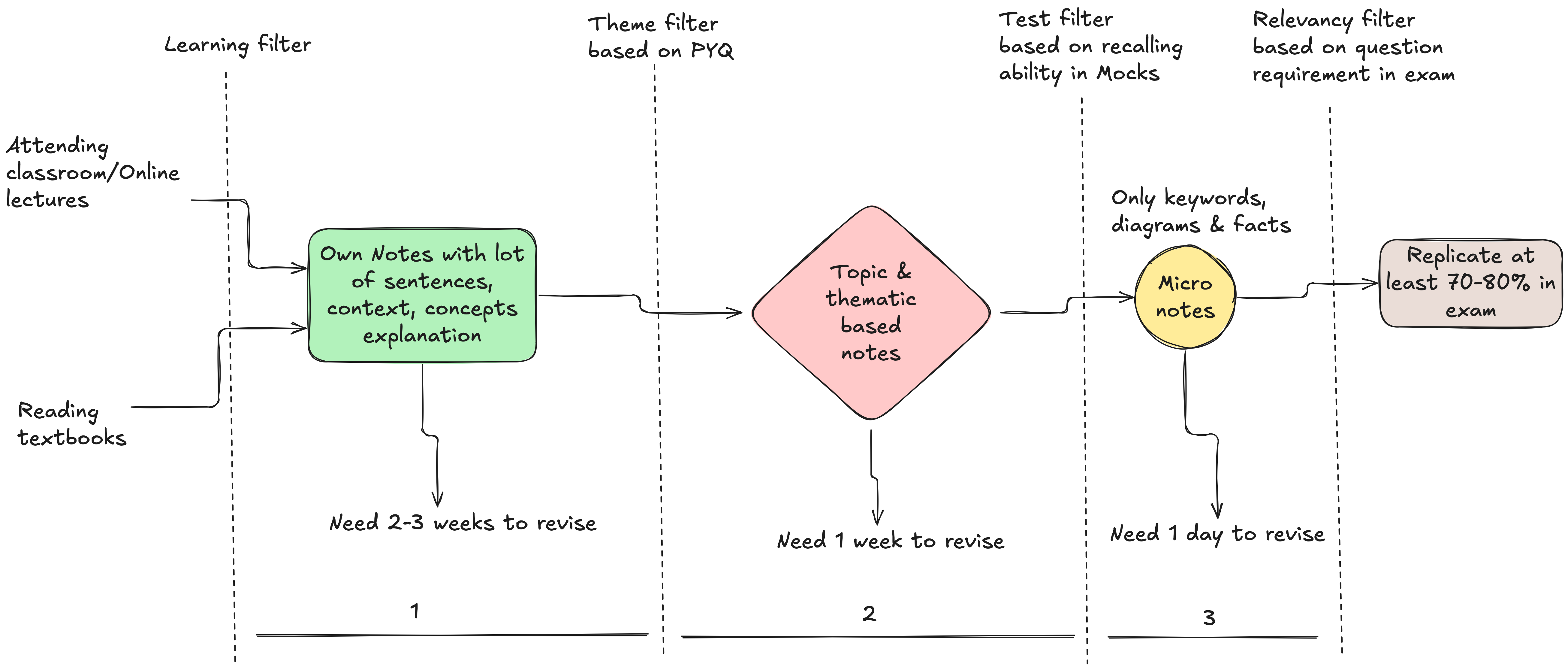
Fig: Stages of note making
Stage 1: These are the notes that you have made while studying from standard textbooks or when you attend lectures.
These notes are verbose and have contextual sentences and hence take longer time to revise (2-3 weeks) before an exam.
Stage 2: These notes are usually made during your 1st or 2nd revision.
Suppose you are revising polity subject, while making the notes, the first sheet should have a list of PYQs and corresponding syllabus keywords. This acts as a guiding polestar to maintain the direction of note making.
Based on this, identify the most important ‘broader themes’ from which questions are asked. This can be Judiciary, Centre-state relations, Devolution and decentralisation, Separation of powers.
Any new information, facts, data that you gather, keep on adding sheets under relevant sections of the themes. This will continue for subsequent revisions and till you take up mock tests.
Stage 3: This is an important stage where your ‘consolidation and consizing’ peaks before the exam.
Keep in mind that whatever these notes consist of, at least 70-80% will be replicated on the answersheet.
Once you start giving mock tests, you will understand what are the key pointers that you are able to recall from stage 2 notes. Only these keywords with additional data, figures, diagrams, facts, pre-framed intro and conclusions must be added to these notes.
This stage is nothing but framework thinking in action. You can make new frameworks for different topics.
Example 1: Governance is an important topic. Micro notes would contain the components of governance as a framework. Any question on governance, the pointers can be recalled with the same framework.
Governance Components:
- Political- Decentralisation
- Economic- Fiscal balance, regional disparity, Ease of doing business.
- Social and environmental- participatory, vulnerable section, sustainability.
- Legal and judicial- Access to justice, delays.
- Administrative- Technology use, transparency, efficiency.
Example 2: Frameworks for recalling a specific topic can also be made. Below is an image for recalling components of Karnataka Budget 2025-26.
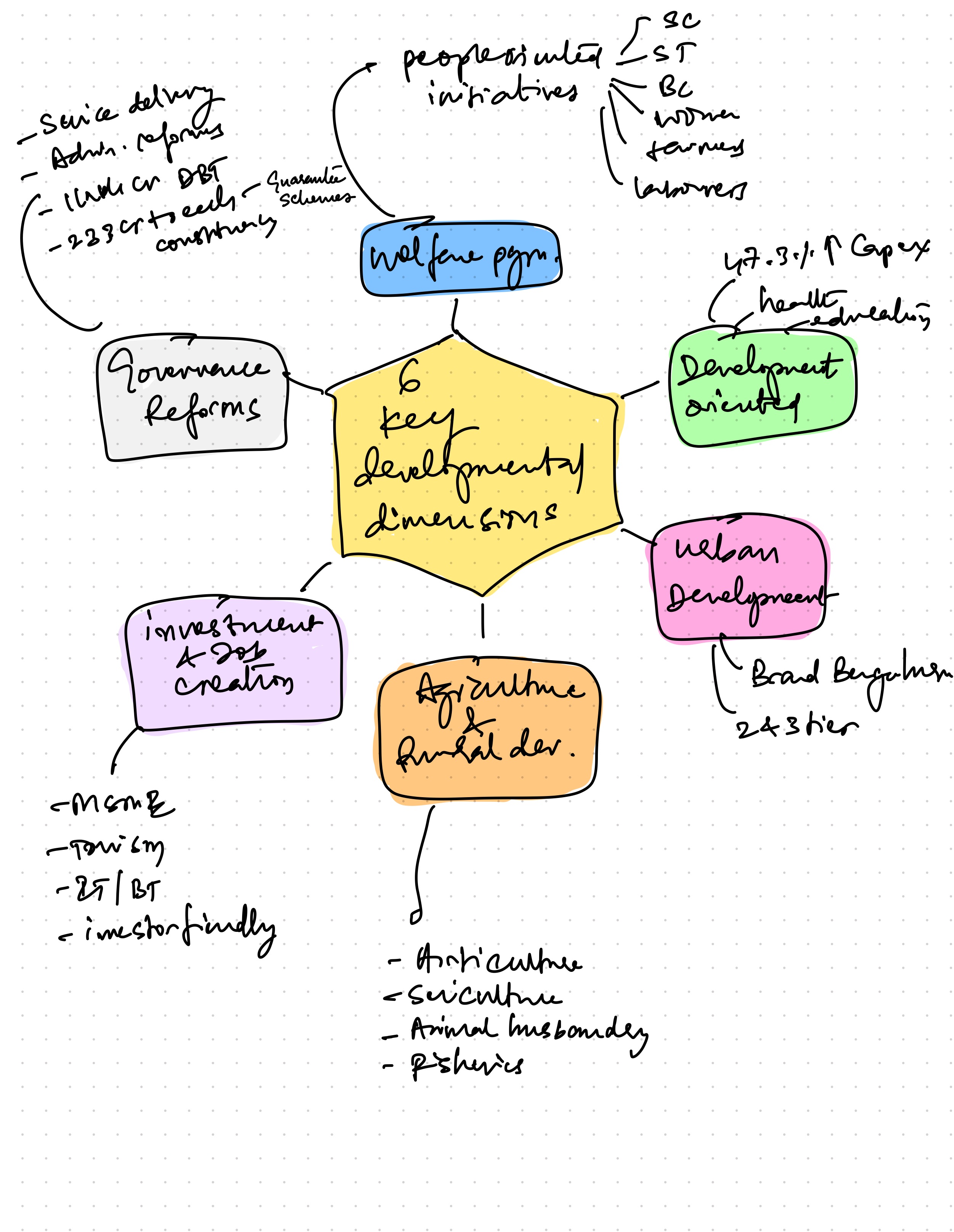 This way the frameworks in micronotes help in your ‘answer structuring’ (more on this later).
3. Deepening neural pathways by actively recalling
In simple terms, this is just ‘revision’. But there is a catch to this. Most times when we are revising, we tend to passively do it by just glancing at the keywords or re-reading things.
Active recall helps to retain what has been studied in the memory for a long time. To actively recall is to forcefully retrieve information stored in the brain by asking ourselves questions. It's like digging a channel for the water flow. It's difficult for the first time, but once that neural pathway is established, it tends to become easier for subsequent retrieval.
On the day of the exam, what you are actually doing is active recall but this process happens naturally. The more hard work you have done before the exam, the easier it is to recall on the day of exam.
With the micronotes and multiple revisions done, you are ready with the ingredients but the khichdi has to be made on the exam day. I have talked about the answer structuring below.
2. Writing the content such that it is relevant to what has been asked in the question
Now you are battle ready with all the work put in before the exam, the next step is to understand what constitutes a good answer.
The idea is to communicate maximum with minimum effort. This constitutes 2 aspects that goes hand in hand.
- Answer structuring
- Content relevancy and diversity
1. Answer structuring
Structuring simply means “placing things in order” such that it is coherent and easy to understand.
The general structure of an answer comprises introduction, body and conclusion. Below is an image where I have tried to explain answer structuring based on the corrector's mindset. This may shed some light on making answers visually appealing.
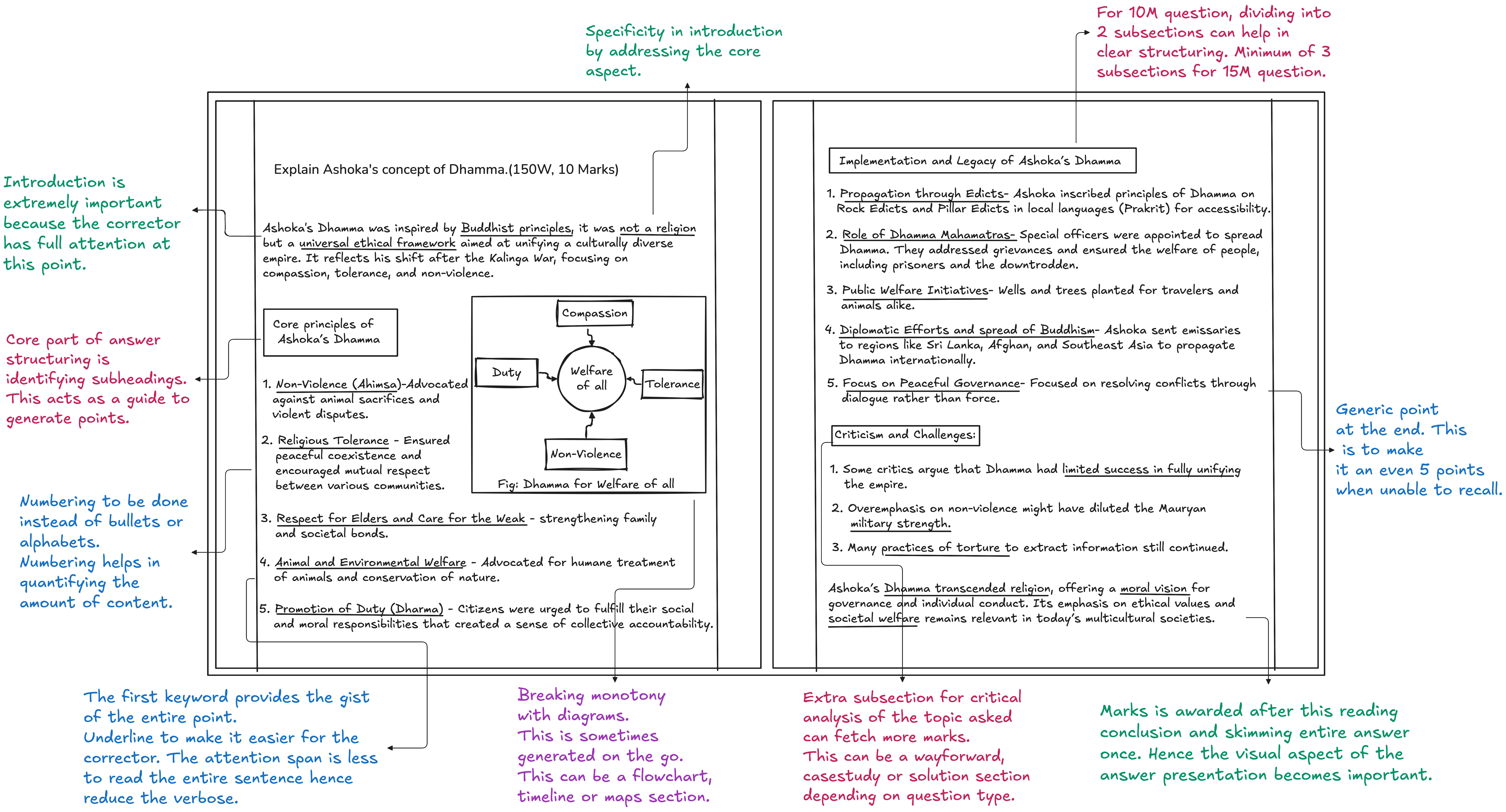 Fig: Parts of an answer from the corrector's perspective.
Some of the important aspects in answer structuring are:
- Clear demarcation of various subsections of the body with box or double underlines.
- Avoid excessive underlining. Only the keywords and 2 word phrases have to be highlighted and anything beyond that looks cluttered.
- Reduction of verbose by making the points crisp. The examiner reads what is easily presented to her and by making it easier visually, the effort of correction is reduced. This will reduce the mental strain or irritation on the examiner (lesser irritation = more marks).
- Numbering of points to create a sense of quantity (The above illustration has 13 points in total).
- Breaking the monotony with diagrams. These diagrams must have clear outline boxing and a short description explaining the diagram (Test out by placing these monotony breakers in various parts of the answer).
2. Content relevancy and diversity
Moving away from the visual aspects of structuring, the core of marks lies in writing the relevant content and addressing all the parts of the question.
If the subsections of the body to be written are generated, then half the battle is won.
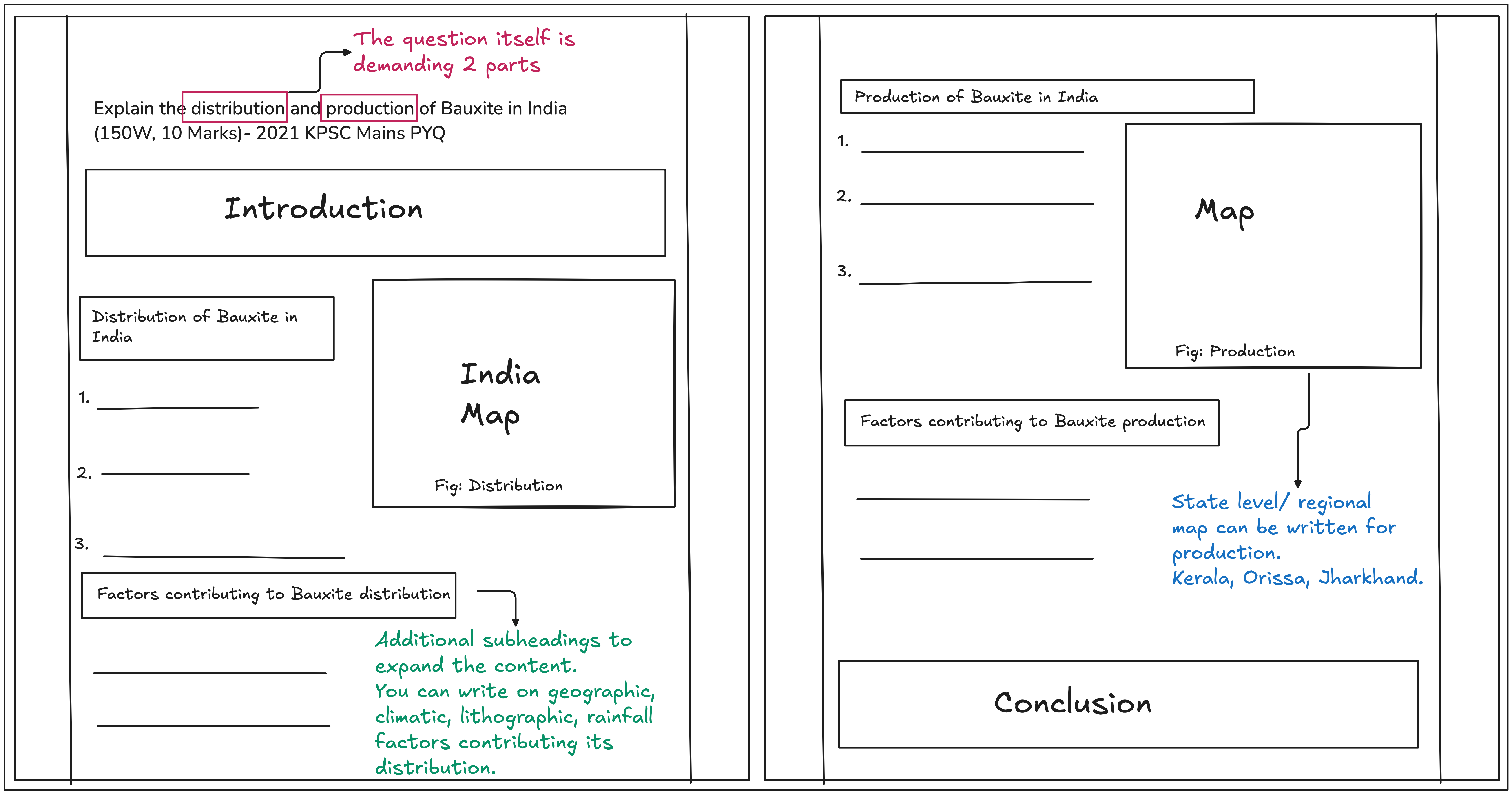 In the above illustration, the subsections could’ve just been 2 parts
- Distribution and production of Bauxite in India
- Factors contributing to distribution and production of Bauxite in India.
But on the contrary, it has been subdivided into 4 parts, separating distribution and production. This is because the factors for production and distribution are different and it is easier to brainstorm more points on the spot if they are divided this way.
The content generated is diverse with lithographic, rainfall, soil, climatic related points. Thus it brings in geography related keywords into the answers and thereby increasing specificity (You will recall these keywords from micronotes).
The ‘anatomy of answer writing’ is a culmination of experiences acquired after writing 4 mains in competitive exams, correcting hundreds of answers and discussion with mentors & aspirant community. Paripaata is a long term mission to solve the problem of rote learning in our study methods.
This is me doing my bit as “ಕೆರೆಯ ನೀರನು ಕೆರೆಗೆ ಚೆಲ್ಲಿ”. Feel free to post your thoughts on the article.
Author :
Nikhil MR (IRMS)
Rank-724 UPSC CSE (2024)
Rank-4 KAS (ALC) (2017-18)
Comments
Be the first to comment.