All 50 questions from this paper with the correct answer and a detailed explanation for each. Covers General Mental Ability, Environment, Higher Education System, Current Affairs, Computer Knowledge, Communication, Research Aptitude, Teaching Aptitude.
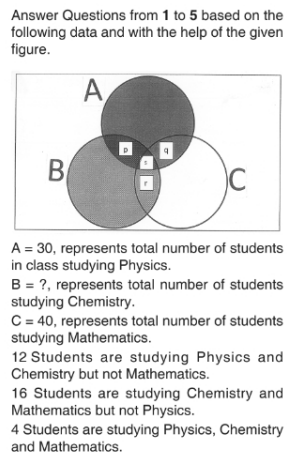
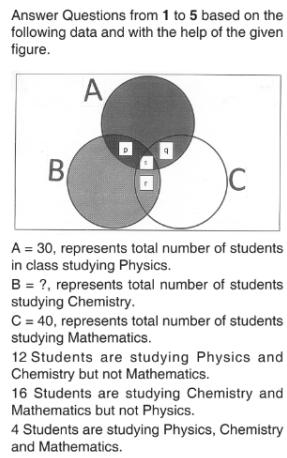
If no student is studying Chemistry alone, what is the total number of students studying Chemistry?
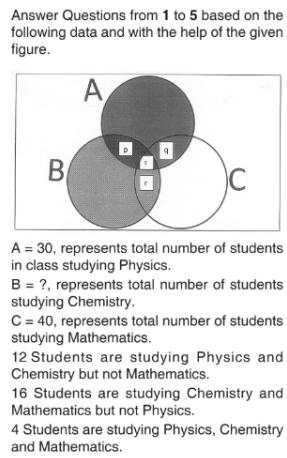
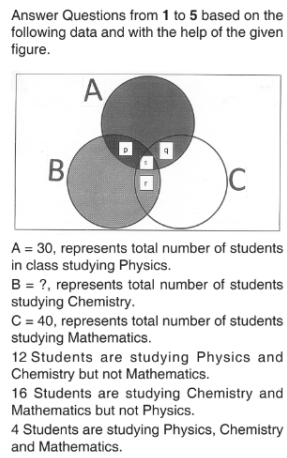
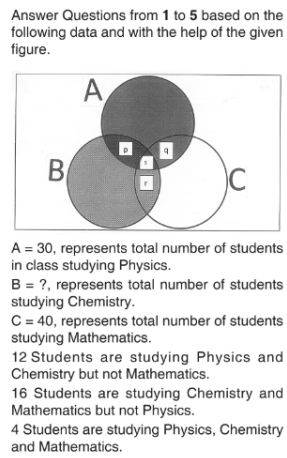
A = 30
total number of students in class studying Physics.
B = ?
total number of students studying Chemistry.
C = 40
total number of students studying Mathematics.
12 Students are studying Physics and Chemistry but not Mathematics.
16 Students are studying Chemistry and Mathematics but not Physics.
4 Students are studying Physics, Chemistry and Mathematics.
A.
30
B.
28
C.
32
Correct
D.
34
Explanation
Chemistry-total = (Chemistry only) + (Physics∩Chemistry only) + (Chemistry∩Maths only) + (all three). Given: Chemistry-only = 0 (no student studies Chemistry alone), Physics∩Chemistry-only = 12, Chemistry∩Maths-only = 16, all three = 4. So Chemistry total = 0 + 12 + 16 + 4 = 32, which is option C.
If students studying Physics and Mathematics, Physics, Chemistry and Mathematics are 14 in number, then what is the value of q ?
A.
6
B.
5
C.
10
Correct
D.
4
Explanation
"Physics and Mathematics" (including those who also study Chemistry) totals 14, i.e. (Physics∩Maths-only) + (all three) = 14. Since all three = 4, Physics∩Maths-only = q = 14 − 4 = 10, which is option C.
What is the percentage of students studying Physics ?
A.
53%
Correct
B.
56%
C.
60%
D.
40%
Explanation
Total students studying Physics = 30 (given), and total class strength = 56 (from Q3). Percentage = 30/56 × 100 ≈ 53.6%, which rounds to the closest offered option, 53% (option A).
What is the ratio of number of students studying only Physics to the number of students studying only Mathematics ?
A.
0.3
B.
0.4
Correct
C.
0.5
D.
0.6
Explanation
Students studying only Physics = 4 and only Mathematics = 10 (derived in Q3's working). Ratio = 4/10 = 0.4, which is option B.
Q6General Mental Ability › Comprehension › Passage Based Questions
Read the following passage carefully and answer the questions 6-10 :
DECOLONIZING THE NORTH
The white man's burden is becoming increasingly heavy for the earth and especially for the South. The past 500 years of history reveal that each time a relationship of colonization has been established between the North and nature and people outside the North, the colonizing men and society have assumed a position of superiority, and thus of responsibility for the future of the earth and for other peoples and cultures. Out of the assumption of superiority flows the notion of the white man's burden. Out of the idea of the white man's burden flows the reality of the burdens imposed by the white man on nature, women and others. Therefore, decolonizing the South is intimately linked to the issue of decolonizing the North.
Gandhi clearly formulated the individuality of freedom not only in the sense that the oppressed of the world are one, but also in the wider sense that the oppressor too, is caught in the culture of oppression. Decolonization in the North is also essential because processes of wealth creation simultaneously create poverty, processes of knowledge creation simultaneously generate ignorance, and processes for the creation of freedom simultaneously generate unfreedom.
In the early phases of colonization, the white man's burden consisted of the need to 'civilize' the non-white peoples of the world — this meant, above all, depriving them of their resources and rights. In the later phase of colonization, the white man's burden consisted of the need to 'develop' the third world, and this again involved depriving local communities of their resources and rights. We are now on the threshold of the third phase of colonization, in which the white man's burden is to protect the environment, especially the third world's environment — and this, too, involves taking control of rights and resources. [. . .]
Ethical decolonization :
From the democracy of all life to man's empire over nature, most non-western cultures have been based on the democracy of all life. As a schoolgirl, one lesson I learnt in the Hindi class was that human beings are part of Vasudhaiva Kutumbakam or the earth family. As a part of the earth family, one participates in the democracy of all life. Rabindranath Tagore, our national poet, wrote that the peak of Indian culture consists in its having defined the principles of life in nature as the highest form of cultural evolution.
The culture of the forest has fuelled the culture of Indian society. The culture that has arisen from the forest has been influenced by the diverse processes of renewal of life which are always at play in the forest, varying from species to species, from season to season, in sight and sound and smell. The unifying principle of life in diversity, of democratic pluralism, thus became the principle of Indian civilization.
As a source of life, nature was venerated as sacred, and human evolution was measured in terms of the human capacity to interact in harmony with her rhythms and patterns, intellectually and emotionally. In the final analyses, the ecological crisis is rooted in the mistaken belief that human beings are not part of the democracy of nature's life, that they stand apart from and above nature.
White man's burden is based on
A.
Real progress made by Europe
B.
Superior technology
C.
False notion of superiority
Correct
D.
Democratic nature of European Societies
Explanation
The passage states the colonizing society "assumed a position of superiority," and that this assumption — not any real achievement — is what generates "the notion of the white man's burden." The whole essay frames this superiority as a false, self-serving belief used to justify colonization, matching option C.
Q7General Mental Ability › Comprehension › Passage Based Questions
Read the following passage carefully and answer the questions 6-10 :
DECOLONIZING THE NORTH
The white man's burden is becoming increasingly heavy for the earth and especially for the South. The past 500 years of history reveal that each time a relationship of colonization has been established between the North and nature and people outside the North, the colonizing men and society have assumed a position of superiority, and thus of responsibility for the future of the earth and for other peoples and cultures. Out of the assumption of superiority flows the notion of the white man's burden. Out of the idea of the white man's burden flows the reality of the burdens imposed by the white man on nature, women and others. Therefore, decolonizing the South is intimately linked to the issue of decolonizing the North.
Gandhi clearly formulated the individuality of freedom not only in the sense that the oppressed of the world are one, but also in the wider sense that the oppressor too, is caught in the culture of oppression. Decolonization in the North is also essential because processes of wealth creation simultaneously create poverty, processes of knowledge creation simultaneously generate ignorance, and processes for the creation of freedom simultaneously generate unfreedom.
In the early phases of colonization, the white man's burden consisted of the need to 'civilize' the non-white peoples of the world — this meant, above all, depriving them of their resources and rights. In the later phase of colonization, the white man's burden consisted of the need to 'develop' the third world, and this again involved depriving local communities of their resources and rights. We are now on the threshold of the third phase of colonization, in which the white man's burden is to protect the environment, especially the third world's environment — and this, too, involves taking control of rights and resources. [. . .]
Ethical decolonization :
From the democracy of all life to man's empire over nature, most non-western cultures have been based on the democracy of all life. As a schoolgirl, one lesson I learnt in the Hindi class was that human beings are part of Vasudhaiva Kutumbakam or the earth family. As a part of the earth family, one participates in the democracy of all life. Rabindranath Tagore, our national poet, wrote that the peak of Indian culture consists in its having defined the principles of life in nature as the highest form of cultural evolution.
The culture of the forest has fuelled the culture of Indian society. The culture that has arisen from the forest has been influenced by the diverse processes of renewal of life which are always at play in the forest, varying from species to species, from season to season, in sight and sound and smell. The unifying principle of life in diversity, of democratic pluralism, thus became the principle of Indian civilization.
As a source of life, nature was venerated as sacred, and human evolution was measured in terms of the human capacity to interact in harmony with her rhythms and patterns, intellectually and emotionally. In the final analyses, the ecological crisis is rooted in the mistaken belief that human beings are not part of the democracy of nature's life, that they stand apart from and above nature.
In the passage North refers to
A.
all countries above the equator
B.
only Scandinavian countries
C.
imperialist European countries
Correct
D.
highly civilized countries
Explanation
Throughout the passage "North" is used as shorthand for the colonizing powers responsible for "500 years" of colonization and for imposing burdens on "the South" — i.e., the historically imperialist European powers, matching option C, not a purely geographic sense (options A, B) or a value-laden claim of civilization (option D).
Q8General Mental Ability › Comprehension › Passage Based Questions
Read the following passage carefully and answer the questions 6-10 :
DECOLONIZING THE NORTH
The white man's burden is becoming increasingly heavy for the earth and especially for the South. The past 500 years of history reveal that each time a relationship of colonization has been established between the North and nature and people outside the North, the colonizing men and society have assumed a position of superiority, and thus of responsibility for the future of the earth and for other peoples and cultures. Out of the assumption of superiority flows the notion of the white man's burden. Out of the idea of the white man's burden flows the reality of the burdens imposed by the white man on nature, women and others. Therefore, decolonizing the South is intimately linked to the issue of decolonizing the North.
Gandhi clearly formulated the individuality of freedom not only in the sense that the oppressed of the world are one, but also in the wider sense that the oppressor too, is caught in the culture of oppression. Decolonization in the North is also essential because processes of wealth creation simultaneously create poverty, processes of knowledge creation simultaneously generate ignorance, and processes for the creation of freedom simultaneously generate unfreedom.
In the early phases of colonization, the white man's burden consisted of the need to 'civilize' the non-white peoples of the world — this meant, above all, depriving them of their resources and rights. In the later phase of colonization, the white man's burden consisted of the need to 'develop' the third world, and this again involved depriving local communities of their resources and rights. We are now on the threshold of the third phase of colonization, in which the white man's burden is to protect the environment, especially the third world's environment — and this, too, involves taking control of rights and resources. [. . .]
Ethical decolonization :
From the democracy of all life to man's empire over nature, most non-western cultures have been based on the democracy of all life. As a schoolgirl, one lesson I learnt in the Hindi class was that human beings are part of Vasudhaiva Kutumbakam or the earth family. As a part of the earth family, one participates in the democracy of all life. Rabindranath Tagore, our national poet, wrote that the peak of Indian culture consists in its having defined the principles of life in nature as the highest form of cultural evolution.
The culture of the forest has fuelled the culture of Indian society. The culture that has arisen from the forest has been influenced by the diverse processes of renewal of life which are always at play in the forest, varying from species to species, from season to season, in sight and sound and smell. The unifying principle of life in diversity, of democratic pluralism, thus became the principle of Indian civilization.
As a source of life, nature was venerated as sacred, and human evolution was measured in terms of the human capacity to interact in harmony with her rhythms and patterns, intellectually and emotionally. In the final analyses, the ecological crisis is rooted in the mistaken belief that human beings are not part of the democracy of nature's life, that they stand apart from and above nature.
The author argues that the attempt by the West to protect the third World's environment is
A.
the need of the day
B.
a historical compulsion
C.
harmful to the third world
Correct
D.
an ethical duty
Explanation
The passage explicitly calls the West's environmental-protection push the "third phase of colonization," noting it "involves taking control of rights and resources" from the third world, just like the earlier 'civilizing' and 'developing' phases did. The author therefore views it as harmful to the third world (option C), not benign (A, D) or merely inevitable (B).
Q9General Mental Ability › Comprehension › Passage Based Questions
Read the following passage carefully and answer the questions 6-10 :
DECOLONIZING THE NORTH
The white man's burden is becoming increasingly heavy for the earth and especially for the South. The past 500 years of history reveal that each time a relationship of colonization has been established between the North and nature and people outside the North, the colonizing men and society have assumed a position of superiority, and thus of responsibility for the future of the earth and for other peoples and cultures. Out of the assumption of superiority flows the notion of the white man's burden. Out of the idea of the white man's burden flows the reality of the burdens imposed by the white man on nature, women and others. Therefore, decolonizing the South is intimately linked to the issue of decolonizing the North.
Gandhi clearly formulated the individuality of freedom not only in the sense that the oppressed of the world are one, but also in the wider sense that the oppressor too, is caught in the culture of oppression. Decolonization in the North is also essential because processes of wealth creation simultaneously create poverty, processes of knowledge creation simultaneously generate ignorance, and processes for the creation of freedom simultaneously generate unfreedom.
In the early phases of colonization, the white man's burden consisted of the need to 'civilize' the non-white peoples of the world — this meant, above all, depriving them of their resources and rights. In the later phase of colonization, the white man's burden consisted of the need to 'develop' the third world, and this again involved depriving local communities of their resources and rights. We are now on the threshold of the third phase of colonization, in which the white man's burden is to protect the environment, especially the third world's environment — and this, too, involves taking control of rights and resources. [. . .]
Ethical decolonization :
From the democracy of all life to man's empire over nature, most non-western cultures have been based on the democracy of all life. As a schoolgirl, one lesson I learnt in the Hindi class was that human beings are part of Vasudhaiva Kutumbakam or the earth family. As a part of the earth family, one participates in the democracy of all life. Rabindranath Tagore, our national poet, wrote that the peak of Indian culture consists in its having defined the principles of life in nature as the highest form of cultural evolution.
The culture of the forest has fuelled the culture of Indian society. The culture that has arisen from the forest has been influenced by the diverse processes of renewal of life which are always at play in the forest, varying from species to species, from season to season, in sight and sound and smell. The unifying principle of life in diversity, of democratic pluralism, thus became the principle of Indian civilization.
As a source of life, nature was venerated as sacred, and human evolution was measured in terms of the human capacity to interact in harmony with her rhythms and patterns, intellectually and emotionally. In the final analyses, the ecological crisis is rooted in the mistaken belief that human beings are not part of the democracy of nature's life, that they stand apart from and above nature.
What is the author's view is essential to Indian civilization ?
A.
Religious attitude
B.
Compassion for others
C.
Democratic pluralism
Correct
D.
Hedonism
Explanation
The passage states directly: "The unifying principle of life in diversity, of democratic pluralism, thus became the principle of Indian civilization," explicitly naming democratic pluralism (option C) as essential to Indian civilization.
Q10General Mental Ability › Comprehension › Passage Based Questions
Read the following passage carefully and answer the questions 6-10 :
DECOLONIZING THE NORTH
The white man's burden is becoming increasingly heavy for the earth and especially for the South. The past 500 years of history reveal that each time a relationship of colonization has been established between the North and nature and people outside the North, the colonizing men and society have assumed a position of superiority, and thus of responsibility for the future of the earth and for other peoples and cultures. Out of the assumption of superiority flows the notion of the white man's burden. Out of the idea of the white man's burden flows the reality of the burdens imposed by the white man on nature, women and others. Therefore, decolonizing the South is intimately linked to the issue of decolonizing the North.
Gandhi clearly formulated the individuality of freedom not only in the sense that the oppressed of the world are one, but also in the wider sense that the oppressor too, is caught in the culture of oppression. Decolonization in the North is also essential because processes of wealth creation simultaneously create poverty, processes of knowledge creation simultaneously generate ignorance, and processes for the creation of freedom simultaneously generate unfreedom.
In the early phases of colonization, the white man's burden consisted of the need to 'civilize' the non-white peoples of the world — this meant, above all, depriving them of their resources and rights. In the later phase of colonization, the white man's burden consisted of the need to 'develop' the third world, and this again involved depriving local communities of their resources and rights. We are now on the threshold of the third phase of colonization, in which the white man's burden is to protect the environment, especially the third world's environment — and this, too, involves taking control of rights and resources. [. . .]
Ethical decolonization :
From the democracy of all life to man's empire over nature, most non-western cultures have been based on the democracy of all life. As a schoolgirl, one lesson I learnt in the Hindi class was that human beings are part of Vasudhaiva Kutumbakam or the earth family. As a part of the earth family, one participates in the democracy of all life. Rabindranath Tagore, our national poet, wrote that the peak of Indian culture consists in its having defined the principles of life in nature as the highest form of cultural evolution.
The culture of the forest has fuelled the culture of Indian society. The culture that has arisen from the forest has been influenced by the diverse processes of renewal of life which are always at play in the forest, varying from species to species, from season to season, in sight and sound and smell. The unifying principle of life in diversity, of democratic pluralism, thus became the principle of Indian civilization.
As a source of life, nature was venerated as sacred, and human evolution was measured in terms of the human capacity to interact in harmony with her rhythms and patterns, intellectually and emotionally. In the final analyses, the ecological crisis is rooted in the mistaken belief that human beings are not part of the democracy of nature's life, that they stand apart from and above nature.
Decolonising the South
A.
Requires the resources of the North
B.
Requires the decolonisation of the North
Correct
C.
Total separation between North and South
D.
Western Technology
Explanation
The passage's opening argument is that "decolonizing the South is intimately linked to the issue of decolonizing the North," i.e., the South's decolonization requires the North to be decolonized too — matching option B.
Q11Environment › International Environmental Efforts › COP & Paris Agreement
'Kyoto protocol' is related to
A.
Ozone depletion
B.
Hazardous waste
C.
Climate change
Correct
D.
Nuclear energy
Explanation
The Kyoto Protocol (1997, under the UNFCCC) is the international treaty committing industrialized nations to binding greenhouse-gas emission reduction targets, making it a climate-change agreement (option C), not related to ozone depletion (Montreal Protocol), hazardous waste (Basel Convention), or nuclear energy.
Q12Higher Education System › History of Higher Education in India › Evolution of Higher Education & Research in Post-Independence India
The first 'Virtual University' of India came up in
A.
Kerala
B.
Andhra Pradesh
C.
Karnataka
D.
Tamil Nadu
Correct
Explanation
Tamil Virtual University, established by the Government of Tamil Nadu in 2001-02 to deliver Tamil-medium and Tamil-studies content online, is recognized as India's first Virtual University, matching option D.
Who inaugurated the 103rd Indian Science Congress at Mysore ?
A.
Pranab Mukharjee
B.
Hamid Ansari
C.
Narendra Modi
Correct
D.
Mrs. Smriti Irani
Explanation
The 103rd Indian Science Congress (January 2016) was held at the University of Mysore and was inaugurated by Prime Minister Narendra Modi, matching option C.
Q14Computer Knowledge › Networking, Internet & Data › Networking Devices, Protocols & Email
Physical path along which data transmission occurs
A.
Encoder
B.
Decoder
C.
Channel
Correct
D.
Bandwidth
Explanation
In data communication terminology, the 'channel' is the physical medium (wire, cable, or wireless link) along which a signal physically travels from sender to receiver, matching option C. An encoder/decoder convert signal representations, and bandwidth is a channel's data-carrying capacity, not the physical path itself.
MIPS is the standard abbreviation for 'Million Instructions Per Second,' a classic measure of a processor's instruction-execution speed, matching option A.
Q16Computer Knowledge › Networking, Internet & Data › Networking Devices, Protocols & Email
A set of standards to handle voice and computer data in telephone networks, providing additional telephone capabilities without scrapping existing copper telephone lines is called
A.
Internet Service Provider
B.
Internet Protocol Network
C.
Integrated Service Provider
D.
Integrated Service Digital Network
Correct
Explanation
ISDN (Integrated Services Digital Network) is precisely the standard designed to carry digitized voice and data over the existing copper telephone network while adding new telephony capabilities, matching option D.
Fly ash is the fine particulate residue produced when pulverized coal is burnt in thermal (coal-fired) power plants, carried out with flue gases and collected via electrostatic precipitators — matching option C, not a generic industrial ash (A), cement dust (B), or plastic-burning smoke (D).
Q18Environment › Conservation & Protected Areas › Environmental Bodies
'Care and share' policy of the forest applies to
A.
Tribal people
B.
Forest communities
C.
Villagers
D.
JFMCs
Correct
Explanation
India's Joint Forest Management (JFM) programme operationalizes a 'care and share' arrangement — local Joint Forest Management Committees (JFMCs) protect and regenerate forest land in partnership with the Forest Department and, in return, share usufruct benefits from the forest, matching option D.
This ecosystem constitutes a systematic link between terrestrial and marine ecosystems
A.
Mango forests
B.
Mangrove forests
Correct
C.
Evergreen forests
D.
Rain forests
Explanation
Mangrove forests grow in the intertidal zone where rivers meet the sea, forming a transitional ecosystem that structurally and functionally links terrestrial and marine ecosystems — nurturing both land-based and marine species — matching option B.
Which is a nodal agency for granting equivalence to degrees awarded by foreign universities?
A.
UGC
B.
Niti Aayog
C.
ICSSR
D.
AIU
Correct
Explanation
The Association of Indian Universities (AIU) is the designated nodal agency in India for granting equivalence to degrees awarded by foreign universities, matching option D.
Q21Higher Education System › Governance, Policy & Administration › National Education Policy & Higher Education Reforms
Vidyalakshmi is a web portal launched by the government for the benefit of students seeking
A.
Higher education
B.
Teacher education
C.
Educational loans
Correct
D.
Scholarships
Explanation
The Vidya Lakshmi portal, launched by the Government of India (Ministries of Finance, HRD and Financial Services), is a single-window platform for students to apply for education loans from multiple banks, matching option C.
Q22Higher Education System › Governance, Policy & Administration › National Education Policy & Higher Education Reforms
Which of the following University has adopted the meta University concept?
A.
Assam University
B.
Pondicherry University
C.
Delhi University
Correct
D.
Hydrabad University
Explanation
Delhi University pioneered the 'Meta University' concept in India — a framework allowing students to combine credits/courses across DU, JNU and IIT-Delhi as though they were one integrated university, matching option C.
Q23Computer Knowledge › Networking, Internet & Data › Networking Devices, Protocols & Email
A combination of hardware and software which links two parts of the same LAN or two compatible LANs by directing messages to the correct node is called
A.
Embedded System
B.
Router
Correct
C.
Hybrid Computer
D.
Microprocessor
Explanation
A router is precisely the networking hardware-and-software device that connects two segments of the same LAN or two compatible LANs, directing (routing) messages/packets to the correct destination node, matching option B.
Q24Computer Knowledge › Computer Fundamentals & Architecture › Computer History, Generations & Number Systems
________ is a process of searching bugs in a software.
A.
Compiling
B.
Testing
C.
Execution
D.
Debugging
Correct
Explanation
Debugging is the standard term for the process of locating and fixing bugs/errors in software, matching option D. Compiling translates source code, testing broadly checks correctness (but does not specifically mean 'searching for bugs'), and execution simply runs a program.
Q25Environment › Biodiversity › Tiger & Wildlife Census
Project Tiger was launched in the year
A.
1983
B.
1993
C.
1973
Correct
D.
2000
Explanation
Project Tiger, India's flagship tiger-conservation programme, was launched in 1973 at Jim Corbett National Park, matching option C.
Q26Communication › Mass Media & Society › Mass Media, Print, Electronic & Digital Communication
The first ever FM services were started in India on
A.
July 23, 1977
Correct
B.
July 23, 1997
C.
July 23, 2007
D.
July 23, 1987
Explanation
All India Radio began its first experimental FM broadcasting service from Madras (Chennai) on 23 July 1977, matching option A.
Q27Communication › Mass Media & Society › Mass Media, Print, Electronic & Digital Communication
ESD, NSD, DD, DCD has one thing in common. What is it?
A.
Viewership
B.
Ownership
Correct
C.
Readership
D.
Leadership
Explanation
ESD, NSD, DD and DCD are all Doordarshan zonal/central broadcasting divisions, and hence all fall under the common ownership of Prasar Bharati (the Government of India's public broadcaster), matching option B.
Q28Communication › Mass Media & Society › Mass Media, Print, Electronic & Digital Communication
Which is the agency of the Central Government that disseminates information regarding government policies and projects to the media in India?
A.
PIB
Correct
B.
PTI
C.
AIR
D.
PCI
Explanation
The Press Information Bureau (PIB) is the Government of India's nodal agency responsible for disseminating information about government policies, programmes and achievements to the print and electronic media, matching option A.
Q29Communication › Mass Media & Society › Mass Media, Print, Electronic & Digital Communication
'Employment News' is published by the publisher of
A.
Times of India
B.
The Week
C.
The Hindu
D.
Yojana
Correct
Explanation
Both 'Employment News' and 'Yojana' are published by the Publications Division, Ministry of Information and Broadcasting, Government of India, matching option D.
Q30Communication › Communication: Nature & Types › Meaning, Characteristics, Types & Functions of Communication
What is AIDA Marketing Communication stands for?
A.
Attraction - Information - Development - Application
B.
Attention - Information - Dialogue - Action
C.
Attention - Interest - Desire - Action
Correct
D.
Attitude - Inspiration - Desire - Action
Explanation
AIDA is the classic marketing-communication model standing for Attention, Interest, Desire, Action — the stages a message is meant to move a prospective customer through, matching option C.
The question below is followed by two arguments (i) and (ii). Decide which of the arguments is “strong” and which is “weak”. Choose the correct answer from the given below.
Statement : India should make voting in elections compulsory for every eligible citizen.
Arguments :
i. Yes, because India spends a lot on elections, which is very important in the Indian context and everyone should vote to make India a true Democracy.
ii. No, because the moment you make things compulsory it is not a truly democratic way of getting things done.
A.
Only the argument (i) is strong
Correct
B.
Only the argument (ii) is strong
C.
Neither argument (i) nor argument (ii) is strong
D.
Both the arguments are strong
Explanation
Argument (i) gives a relevant, direct reason connecting the cost of elections to the value of universal participation for a 'true Democracy,' so it is strong. Argument (ii) merely asserts a definitional contradiction ('compulsory' vs 'democratic') without substantive reasoning about compulsory voting's actual effects, so it is weak. Hence only (i) is strong — option A.
In the following question a statement is followed by two assumptions (i) and (ii). An assumption is something supposed or taken for granted. Consider the statement and the following assumptions and decide which of the following assumptions is implicit in the statement ?
Statement : If it does not rain throughout this season, most farmers would be in trouble this year.
Assumptions :
i. Most farmers are generally dependent on rains.
ii. Timely rainfall is essential for farming.
A.
Only assumption (i) is implicit
B.
Only assumption (ii) is implicit
C.
Neither assumption (i) nor (ii) is implicit
D.
Both the assumptions are implicit
Correct
Explanation
The statement's logic — 'no rain → farmers in trouble' — only holds if farmers generally rely on rain for their livelihood (assumption i) and if timely rainfall is in fact essential to farming (assumption ii); both underlying beliefs must be taken for granted for the statement to make sense, so both assumptions are implicit, matching option D.
No contemporary is an heir.
Which of the following inference can be drawn from the above statements?
A.
Some contemporaries are heirs
B.
Some heirs are ancestors
Correct
C.
No ancestor is a contemporary
D.
No heir is an ancestor
Explanation
Statement 2, 'Few ancestors are heirs' (an I-type/particular statement: 'Some ancestors are heirs'), validly converts to 'Some heirs are ancestors' by simple conversion of a particular affirmative — this is exactly option B. Option A contradicts statement 3 ('No contemporary is an heir'); option C wrongly converts the universal statement 1; option D contradicts statement 2.
Choose the pair of words which shows the same relationship as given at the top.
Biography : Autobiography :: ?
A.
Memories : History
B.
Author : Performer
C.
Mobile : Automobile
D.
Testimony : Confession
Correct
Explanation
A biography is an account of a person's life written by someone else, while an autobiography is written by the subject about themselves — an 'about another' vs 'about oneself' pairing. Testimony is a formal statement given about events/others (typically as a witness), while a confession is a self-made admission about one's own actions — the same 'given about another' vs 'given about oneself' relationship, matching option D.
Among the four terms marked A – D, three terms are similar and one is dissimilar. Find the one that is not similar.
A.
Shehnai
B.
Flute
C.
Trumpet
D.
Violin
Correct
Explanation
Shehnai, Flute and Trumpet are all wind instruments (played by blowing air), whereas Violin is a string instrument (played with a bow) — making Violin the odd one out, option D.
Q36General Mental Ability › Basic Numeracy › Ratio & Proportion
A, B and C together can complete a piece of work in 10 days. All the three started working at it together and after 4 days 'A' left. Then B and C together completed the work in 10 more days. 'A' alone can complete the work in
A.
15 days
B.
16 days
C.
25 days
Correct
D.
26 days
Explanation
A, B and C together complete the work at a combined rate of 1/10 per day. In 4 days they finish 4/10 = 2/5 of the work, leaving 3/5. B and C then finish this 3/5 in 10 days, so B+C's rate = (3/5)/10 = 3/50 per day. A's rate = combined rate − (B+C)'s rate = 5/50 − 3/50 = 2/50 = 1/25 per day, so A alone takes 25 days, matching option C.
Q37General Mental Ability › Basic Numeracy › Numbers & Number Systems
Complete the series:
132, 182, 306, 380, 552, 870, ____
A.
930
B.
992
Correct
C.
1010
D.
1142
Explanation
Each term is n×(n+1) where n runs through consecutive primes starting at 11: 11×12=132, 13×14=182, 17×18=306, 19×20=380, 23×24=552, 29×30=870. The next prime after 29 is 31, so the next term is 31×32 = 992, matching option B.
If PURCHASE is coded as PRHSEACU, then how SUITABLE will be coded ?
A.
SIAELBTU
B.
SIALBETU
C.
SIABELTU
D.
SIALEBTU
Correct
Explanation
In PURCHASE → PRHSEACU, the code reorders the letters as: odd positions (1,3,5,7) in ascending order followed by even positions (8,6,4,2) in descending order — P,R,H,S (positions 1,3,5,7) then E,A,C,U (positions 8,6,4,2). Applying the same rule to SUITABLE (S-U-I-T-A-B-L-E): odd positions (1,3,5,7) give S,I,A,L, and even positions in descending order (8,6,4,2) give E,B,T,U, yielding SIALEBTU, matching option D.
Q39General Mental Ability › Basic Numeracy › Ratio & Proportion
The price of 7 apples is equal to the cost of 3 melons. The price of 2 melons is equal to the cost of an apple and five oranges. If you had just enough money to buy 30 oranges, then how many apples you would buy with the same amount?
A.
22
Correct
B.
25
C.
30
D.
32
Explanation
7 apples = 3 melons, so 1 melon = 7/3 apples. 2 melons = 1 apple + 5 oranges, so 2×(7/3) apples = 1 apple + 5 oranges → 14/3 apples − 1 apple = 5 oranges → 11/3 apples = 5 oranges → 1 orange = 11/15 apple. Money for 30 oranges = 30 × (11/15) apples worth = 22 apples, matching option A.
'A' walks around a circular field at the rate of one round per hour, while 'B' runs around it at the rate of six rounds per hour. They start in the same direction from the same point at 7.30 A.M. They shall first cross each other at
A.
8.30 A.M.
B.
8.10 A.M.
C.
7.48 A.M.
D.
7.42 A.M.
Correct
Explanation
A completes 1 round/hour and B completes 6 rounds/hour in the same direction, so B gains on A at a relative rate of 5 rounds/hour. Starting together, they first cross when B has gained exactly 1 full round on A, which takes 1/5 hour = 12 minutes. Starting at 7:30 A.M., they first cross at 7:42 A.M., matching option D.
Q41Research Aptitude › Research: Meaning, Types & Characteristics › Meaning, Scope, Types & Characteristics of Research
A research hypothesis is a
A.
Theory
B.
Principle
C.
Tentative proposition
Correct
D.
Postulate
Explanation
A research hypothesis is, by definition, a tentative, testable proposition about the relationship between variables, put forward to be verified or refuted through research — matching option C, not an established theory or postulate, which imply a higher degree of certainty.
Q42Research Aptitude › Research: Meaning, Types & Characteristics › Meaning, Scope, Types & Characteristics of Research
What is Encyclopaedia edited content called as?
A.
Primary Source
B.
Infinite Source
C.
Continuous Source
D.
Secondary Source
Correct
Explanation
An encyclopaedia compiles, interprets and synthesizes information that was originally reported elsewhere, rather than presenting first-hand/original data — this makes it a secondary source, matching option D.
Q43Research Aptitude › Methods & Approaches › Qualitative, Quantitative & Mixed Methods of Research
Which is the process not needed in experimental research?
A.
Manipulation and Replication
B.
Controlling
C.
Observation
D.
Absence of treatment group
Correct
Explanation
Experimental research requires manipulation of the independent variable, replication for reliability, careful controlling of extraneous variables, and observation of outcomes — but it specifically requires the presence of a treatment (experimental) group as well as a control group; 'absence of a treatment group' is not a feature it needs, matching option D.
When two or more successive footnotes refer to the same work, which one of the following is used?
A.
ibid
Correct
B.
et.al
C.
op.cit
D.
loc.cit
Explanation
'Ibid.' (Latin 'ibidem', meaning 'in the same place') is used in footnotes when two or more successive citations refer to the very same source, matching option A. 'Op. cit.' and 'loc. cit.' are used when the same source is cited again after other citations have intervened.
Q45Research Aptitude › Research: Meaning, Types & Characteristics › Meaning, Scope, Types & Characteristics of Research
What is the research that aims at immediate application?
A.
Action Research
Correct
B.
Empirical Research
C.
Conceptual Research
D.
Fundamental Research
Explanation
Action research is defined as research undertaken to solve an immediate, practical problem in a specific context, i.e., it aims at immediate application, matching option A — unlike fundamental/empirical research, which primarily aim to build general knowledge.
Q46Teaching Aptitude › Methods, Aids & Approaches › Methods of Teaching (Teacher-Centred vs Learner-Centred)
Which one of the following is the most effective mode of learning in the present days?
A.
self-study
B.
blended learning
Correct
C.
face to face learning
D.
e-learning
Explanation
Blended learning combines face-to-face instruction with online/technology-enabled learning, drawing on the strengths of both self-paced digital resources and direct teacher interaction, which is why it is widely regarded as the most effective mode of learning today, matching option B.
Q47Higher Education System › Education Systems & Approaches › Value Education & Environmental Education
Which one of the following is the aim of Value Education?
A.
to inculcate moral values
Correct
B.
to inculcate social values
C.
to inculcate political values
D.
to inculcate economic values
Explanation
Value Education is specifically aimed at inculcating moral values — honesty, integrity, empathy, ethical conduct — in learners, matching option A, distinct from social, political or economic education.
Q48Teaching Aptitude › Methods, Aids & Approaches › Methods of Teaching (Teacher-Centred vs Learner-Centred)
Lecture method is least effective in the learning of the following
A.
Aptitudes
B.
Attitudes
C.
Relationships
D.
Skill
Correct
Explanation
The lecture method is a one-way, teacher-centred verbal transmission of information, well suited to conveying facts, attitudes and conceptual relationships, but it offers no hands-on practice or demonstration — making it least effective for developing a practical skill, matching option D.
Q49Teaching Aptitude › Methods, Aids & Approaches › Methods of Teaching (Teacher-Centred vs Learner-Centred)
Which of the following techniques used by a teacher to teach include?
Lecture
Interactive lecture
Group work
Self-study
Codes :
A.
1, 2, 3 and 4
B.
1, 2, 3 only
Correct
C.
1 and 2 only
D.
1, 3 and 4
Explanation
Lecture, interactive lecture and group work are all recognized techniques a teacher actively uses to deliver instruction in a classroom. Self-study, by contrast, is carried out independently by the learner and is not a technique the teacher 'uses to teach' — so only 1, 2 and 3 qualify, matching option B.
Q50Teaching Aptitude › Methods, Aids & Approaches › Methods of Teaching (Teacher-Centred vs Learner-Centred)
Which of the following is not a teaching method?
A.
Buzz group
B.
Brain storming
C.
Gossip
Correct
D.
Role plays
Explanation
Buzz groups, brainstorming and role plays are all recognized, structured teaching/instructional methods used to actively engage learners. Gossip is casual, unstructured social talk with no pedagogical structure or intent, so it is not a teaching method, matching option C.