All 50 questions from this paper with the correct answer and a detailed explanation for each. Covers Communication, Computer Knowledge, General Mental Ability, Higher Education System, Schemes & Social Justice, Research Aptitude, Applied Science & Technology, Environment, Biology, International Relations, Teaching Aptitude.
Q1Communication › Communication: Nature & Types › Meaning, Characteristics, Types & Functions of Communication
Given below are two statements, one is labelled as Assertion (A) and the other labelled as Reason (R).
Assertion (A): Formal communication tends to be fast and flexible.
Reason (R): Formal communication is a systematic and orderly flow of information.
In the context of the above statements, which of the following is correct?
Codes:
A.
Both (A) and (R) are true and (R) is the correct explanation of (A)
B.
Both (A) and (R) are true, but (R) is not the correct explanation of (A)
C.
(A) is true, but (R) is false
D.
(A) is false, but (R) is true
Correct
Explanation
Formal communication flows through officially defined channels (hierarchy, memos, reports) and is characteristically slow and rigid, not fast and flexible — those traits describe informal/grapevine communication instead, so Assertion (A) is false. Reason (R), however, is an accurate description: formal communication is indeed a systematic, orderly flow of information through prescribed organisational channels, so (R) is true. Hence (A) is false, but (R) is true.
Q2Communication › Communication: Nature & Types › Meaning, Characteristics, Types & Functions of Communication
The mode of communication that involves a single source transmitting information to a large, diversified, heterogeneous and dispersed audience simultaneously, is called
A.
Group Communication
B.
Mass Communication
Correct
C.
Intrapersonal Communication
D.
Public Communication
Explanation
This is the textbook definition of mass communication: one source (e.g., a newspaper, TV broadcaster, or website) transmits a message simultaneously to a large, heterogeneous and geographically dispersed audience via a mass medium. Group communication involves a small, defined set of participants; intrapersonal communication is communication within oneself; public communication is a speaker addressing a physically co-present audience, not a dispersed mass one.
Q3Computer Knowledge › Networking, Internet & Data › Data Formats, Encoding & Databases
Encoding or scrambling data for transmission across a network is known as
A.
Protection
B.
Decryption
C.
Encryption
Correct
D.
Decoding
Explanation
Encryption is the process of converting plain data into a scrambled, unreadable form (ciphertext) before transmission, so that only an authorised recipient with the correct key can read it. Decryption is the reverse process (converting ciphertext back to plaintext), decoding is the general reverse of encoding, and 'protection' is not a specific technical term for this process.
Q4Communication › Mass Media & Society › Communication and Media Literacy
Ideological codes shape our collective
A.
Perceptions
Correct
B.
Consumptions
C.
Creations
D.
Productions
Explanation
In media and cultural studies, 'ideological codes' are the underlying value systems and belief structures embedded in media texts (e.g., codes around individualism, patriarchy, consumerism) that shape how audiences collectively perceive and interpret reality — i.e., they shape collective perceptions, not directly consumption, creation, or production activities.
Q5Communication › Mass Media & Society › Mass Media, Print, Electronic & Digital Communication
What is Twitter handle?
A.
Tweet
B.
Twitter URL
C.
Hashtag
D.
Username
Correct
Explanation
A 'Twitter handle' refers to the unique username of an account, prefixed with '@' (e.g., @username), used to identify and mention users on the platform. It is distinct from a tweet (a posted message), a hashtag (a topic tag prefixed with '#'), or a URL.
In a certain code language, SHOOT has been coded as 21−10−17−17−22. How will you code TELLY in the same code language?
A.
18−10−12−12−2
B.
22−7−20−14−6
C.
22−5−14−14−25
D.
22−7−14−14−27
Correct
Explanation
The code adds 2 to each letter's position in the alphabet: S=19→21, H=8→10, O=15→17, O=15→17, T=20→22, giving 21-10-17-17-22, which matches. Applying the same rule (+2) to TELLY: T=20→22, E=5→7, L=12→14, L=12→14, Y=25→27, giving 22-7-14-14-27, which is option D.
Q7General Mental Ability › Basic Numeracy › Numbers & Number Systems
The flowers kept in the basket doubles in every one minute. If the basket gets completely full by flowers in 30 minutes, then in how many minutes 41th of the basket was filled with flowers?
A.
215 minutes
B.
15 minutes
C.
28 minutes
Correct
D.
245 minutes
Explanation
Since the quantity doubles every minute, working backwards from a full basket at minute 30: the basket was half-full at minute 29 (30-1) and quarter-full at minute 28 (30-2), because halving the full amount twice gives one quarter. So the basket was 1/4th full at 28 minutes.
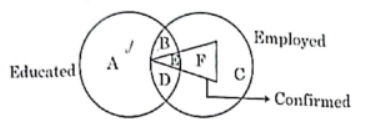
Study the following Venn diagram and find the region representing persons who are educated and employed but not confirmed.
A.
A, C
B.
A, B, C
C.
B, D
Correct
D.
B, E, D
Explanation
The three-circle Venn diagram partitions the population by the attributes educated, employed and confirmed; the region(s) satisfying 'educated AND employed but NOT confirmed' correspond to the overlap of the educated and employed circles excluding the part shared with the confirmed circle — labelled B and D in the original figure, matching the marked answer.
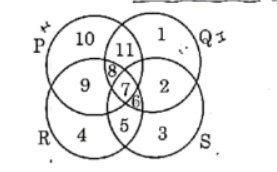
In the given figure, circle 'P' represents hard-working people, circle 'Q' represents intelligent people, circle 'R' represents truthful people and circle 'S' represents honest people. Which region represents the people who are intelligent, honest and truthful but not hard-working?
A.
6
Correct
B.
7
C.
8
D.
5
Explanation
In the four-circle Venn diagram, the region required is the overlap of intelligent (Q), truthful (R) and honest (S) circles that lies outside the hard-working (P) circle — this is region 6 in the original figure, matching the marked answer.
If 'red' is called 'air', 'air' is called 'black', 'black' is called 'sky', 'sky' is called 'blue', 'blue' is called 'wind' and 'wind' is called 'white'. Then what is the colour of 'sky'?
A.
White
B.
Black
C.
Blue
Correct
D.
Red
Explanation
The statements form a list of direct substitutions, and the question asks about the term 'sky' specifically. The statement 'sky' is called 'blue' directly gives the answer for 'sky' — it is called blue. No further chain-tracing is needed since 'sky' appears explicitly on the left-hand side of one of the given statements.
Q11Higher Education System › Education Systems & Approaches › Value Education & Environmental Education
Given below are two statements, one is labelled as Assertion (A) and the other labelled as Reason (R).
Assertion (A) : The purpose of higher education is to promote critical and creative thinking abilities among students.
Reason (R) : Their abilities ensure job placements.
In the context of the above statements, which of the following is correct?
Codes:
A.
Both (A) and (R) are true and (R) is the correct explanation of (A)
B.
Both (A) and (R) are true, but (R) is not the correct explanation of (A)
Correct
C.
(A) is true, but (R) is false
D.
(A) is false, but (R) is true
Explanation
Assertion (A) is true: promoting critical and creative thinking is a widely accepted core purpose of higher education. Reason (R) — that these abilities 'ensure job placements' — is also generally true in a loose sense (such skills are valued by employers), but it is not the correct explanation of why higher education aims to develop these abilities; the purpose is rooted in holistic intellectual and civic development, not merely employability outcomes. Hence both are true, but (R) does not correctly explain (A).
Q12Higher Education System › Education Systems & Approaches › Value Education & Environmental Education
The best way for providing value education is through
A.
Discussions on spiritual texts
B.
Lectures/discussions on values
C.
Seminars/symposia on values
D.
Mentoring/reflective sessions on values
Correct
Explanation
Value education research and pedagogy consistently favour experiential, reflective approaches — mentoring and reflective sessions that let learners internalise and apply values — over passive transmission methods like lectures, seminars, or text-based discussions, which convey information about values but do not effectively instil them.
Q13Higher Education System › Governance, Policy & Administration › National Education Policy & Higher Education Reforms
Which of the following is not a salient feature of NEP 2020?
A.
Highest priority to achieving foundational literacy and numeracy by all students by Grade 3
B.
Learners' flexibility to choose their learning objectives and programmes
C.
Promoting multilingualism and the power of language in teaching and learning
D.
Focus on summative assessment rather than the regular formative assessment of learning
Correct
Explanation
NEP 2020 explicitly shifts assessment culture away from high-stakes, rote summative testing toward regular formative, competency-based assessment that tests higher-order skills. Option D describes the opposite of NEP 2020's actual stance, so it is correctly identified as not a salient feature; options A, B and C are genuine, well-documented NEP 2020 provisions.
Which of the following is not a product of Pradhan Mantri Mudra Yojana?
A.
Shishu
B.
Naari
Correct
C.
Kishore
D.
Tarun
Explanation
Pradhan Mantri Mudra Yojana (PMMY) offers loans under three categories based on loan size and stage of business: 'Shishu' (up to ₹50,000), 'Kishore' (₹50,000 to ₹5 lakh) and 'Tarun' (₹5 lakh to ₹10 lakh). 'Naari' is not one of the scheme's categories, so it is the correct answer.
NIRF stands for National Institutional Ranking Framework, the methodology adopted by India's Ministry of Education (via the MHRD) to rank higher educational institutions across parameters like teaching, research, and outreach — not a 'research' or 'integrated' framework as the distractor options suggest.
Find the ratio between total number of workers in Company A and Company B to total number of officers in Company A and Company B.
A.
25:1
Correct
B.
18:1
C.
1:23
D.
1:16
Explanation
Solving the system consistently with all five questions in this set (using officer:worker ratios 1:35, 1:20, 1:15, total workers = 1200, total officers = 56, and officers(B) − officers(C) = 4) gives officers A=12, B=24, C=20 and workers A=420, B=480, C=300 (summing to 1200, with 12+24+20=56 officers). Workers(A)+Workers(B) = 420+480 = 900; Officers(A)+Officers(B) = 12+24 = 36. Ratio = 900:36 = 25:1.
Total workers = 1200
Total number of employees in Company B exceeds the total number of employees in Company C by
A.
200
B.
180
C.
184
Correct
D.
172
Explanation
Using the same derived values (workers B=480, officers B=24, total employees B=504; workers C=300, officers C=20, total employees C=320), the difference is 504 − 320 = 184.
What is the total number of officers in the three companies?
A.
56
Correct
B.
66
C.
72
D.
84
Explanation
Using the derived values, officers A=12, B=24, C=20, giving a total of 12+24+20 = 56, which is internally consistent with all other answers in this data set (workers 420+480+300=1200, matching the given total).
The difference in the number of officers in Company 'B' and Company 'C' is
A.
4
Correct
B.
5
C.
8
D.
12
Explanation
Officers in Company B = 24, officers in Company C = 20 (from the consistent solution derived for this data set), giving a difference of 4.
Q21Research Aptitude › Research: Meaning, Types & Characteristics › Steps of Research & Research Process
Which sequence of research steps is logical in the list given below?
A.
Problem formulation, data analysis, development of research design, hypothesis formulation, collection of data, arriving at generalisations and conclusions
B.
Problem formulation, hypothesis formulation, development of research design, collection of data, data analysis, arriving at generalisations and conclusions
Correct
C.
Development of research design, hypothesis formulation, problem formulation, data analysis, collection of data, arriving at generalisations and conclusions
D.
Collection of data, development of research design, data analysis, problem formulation, hypothesis formulation, arriving at generalisations and conclusions
Explanation
The standard research process proceeds: identify/formulate the problem, formulate a hypothesis, design the research methodology, collect data, analyse the data, and finally arrive at generalisations/conclusions. Option B is the only sequence that follows this logical order.
Q22Research Aptitude › Methods & Approaches › Qualitative, Quantitative & Mixed Methods of Research
What is Netnography?
A.
Digital investigation
B.
Market research of netizens
C.
Social media research
D.
Online ethnography research
Correct
Explanation
Netnography (a portmanteau of 'internet' and 'ethnography') is a qualitative research method that adapts traditional ethnographic techniques to study cultures and communities emerging through online/computer-mediated communication — i.e., it is online ethnography research.
Q23Research Aptitude › Research: Meaning, Types & Characteristics › Meaning, Scope, Types & Characteristics of Research
Which one of these books is authored by Fred N. Kerlinger ?
A.
Foundations of Behavioural Research
Correct
B.
Methods in Social Research
C.
Scientific Social Surveys and Research
D.
Sociological Research Methods
Explanation
'Foundations of Behavioral Research' is the well-known research methodology textbook authored by Fred N. Kerlinger, widely cited in social science and educational research courses. The other titles are associated with different authors (e.g., Goode & Hatt for 'Methods in Social Research', Pauline V. Young for 'Scientific Social Surveys and Research').
Hypothesis that assigns value of zero to the variable
C.
Hypothesis of zero significance
D.
Hypothesis which can neither be proved nor disproved
Explanation
A null hypothesis (H₀) is a statistical hypothesis that states there is no difference or no relationship between the variables/groups being studied — it is the hypothesis of 'no difference', which the researcher tests and attempts to reject/accept based on data, not a hypothesis about zero values of a variable or an untestable claim.
When a research problem is related to heterogeneous population, which of the following is the most suitable sampling method ?
A.
Cluster sampling
B.
Stratified sampling
Correct
C.
Convenient sampling
D.
Simple random sampling
Explanation
Stratified sampling divides a heterogeneous population into relatively homogeneous subgroups (strata) based on shared characteristics, then samples from each stratum — this ensures adequate representation of all subgroups, making it the most suitable method for heterogeneous populations, unlike cluster, convenience or simple random sampling.
An unsolicited e-mail, message sent to many recipients at once, is a
A.
Worm
B.
Virus
C.
Threat
D.
Spam
Correct
Explanation
An unsolicited bulk email/message sent to many recipients at once is, by definition, spam. A worm and a virus are types of self-replicating malicious software, not unsolicited bulk messages, and 'threat' is too generic a term for this specific phenomenon.
Q27Computer Knowledge › Cybersecurity › Data Security, Firewalls & Protection
What is the difference between Signal and Telegram ?
A.
Signal is a fully open source
Correct
B.
Telegram is fully open source
C.
Signal collects data along with phone number
D.
Telegram data not linked to phone number
Explanation
Signal's client apps, server code, and its Signal Protocol encryption are all fully open source and independently audited. Telegram, by contrast, keeps its server-side code closed/proprietary and uses its own custom (and less scrutinised) MTProto protocol — so 'Signal is fully open source' is the accurate differentiator; the other options misstate the actual data-collection and open-source characteristics of the two apps.
Q28Communication › Mass Media & Society › Mass Media, Print, Electronic & Digital Communication
Which is the largest TV experiment of India ?
A.
GRAMSAT
B.
Jhabua - JDCP
C.
Kheda Communication Project
D.
SITE
Correct
Explanation
SITE (Satellite Instructional Television Experiment, 1975-76), conducted using the ATS-6 satellite to beam educational programmes to about 2,400 villages across six states, is recognised as the largest television experiment undertaken in India — larger in scale than the more localised GRAMSAT, Jhabua Development Communication Project, or Kheda Communication Project.
Q29Applied Science & Technology › Information & Communication Technology › Digital governance
The National Informatics Centre launched an instant messaging platform (app.) on the lines of WhatsApp in February 2021. Identify the app.
A.
Sandesh
Correct
B.
Varta
C.
Sahyog
D.
Khabar
Explanation
The National Informatics Centre (NIC) launched 'Sandes' (also styled Sandesh), the Government Instant Messaging System (GIMS), in February 2021 as a WhatsApp-like secure messaging platform for government and public use. 'Varta', 'Sahyog' and 'Khabar' are not the names of this platform.
Q30Computer Knowledge › Networking, Internet & Data › Data Formats, Encoding & Databases
What is Dashboard ?
A.
It is a scorecard
B.
Information Management Tool
Correct
C.
Health Information Management Tool
D.
Cloud storage
Explanation
A dashboard is a visual information management tool that consolidates and displays key data/metrics from multiple sources on a single interface for quick monitoring and decision-making — a general-purpose concept, not specific to health data (option C), not simply a 'scorecard' (a narrower, specific reporting format), and not a storage mechanism.
Q31General Mental Ability › Comprehension › Passage Based Questions
Read the passage given below and answer the questions from 31 to 35 based on your understanding of the passage.
A Delhi court's acquittal of journalist Priya Ramani in the criminal defamation complaint filed by celebrity editor-politician M.J. Akbar will embolden women survivors of sexual harassment at workplaces to speak up. "The woman has a right to put her grievance at any platform of her choice and even after decades," the court said, directly answering those who questioned women coming out with their #MeToo accounts after considerable passage of time, and those who questioned their choice of social media platforms rather than law enforcement mechanisms to air grievances.
Many women will gain confidence from the court believing the testimonies of Ramani and fellow journalist Ghazala Wahab on their harassment. The woman's struggle to be believed by society, to resist social stigma, to convince herself to recognise the abuse, to overcome the mental trauma and gain confidence to expose the abuser have rightly found mention in the judgment. The woman cannot be punished for raising voice against the sex abuse on the pretext of criminal complaint of defamation as the right of reputation cannot be protected at the cost of the right of life and dignity of woman as guaranteed by the Indian Constitution", wrote ACMM R.K. Pandey.
The court's privileging of fundamental rights over restrictive legal provisions like criminal defamation that silence victims of injustice and the free press is heartening. To Ramani's credit she didn't baulk at having to join a long legal fight. The conversation over sexual harassment and women's safety at workplaces has come a long way since Supreme Court framing the Vishaka guidelines in 1997. Since 2013, India has the Sexual Harassment at Workplaces (Prevention, Prohibition and Redressal) Act placing statutory responsibilities upon employers and a clearly defined penal provision criminalising sexual harassment (IPC Section 3544).
Yet, it is still a long, lonely path for women because the harasser is almost always a senior in the organisation, enjoying grent power and influence. Ramani told reporters of having to deal with anxiety, stress and fear in her fight as well as the irony of her having to stand in court as the accused. The verdict's succinct yet powerful recognition of her act of "self-defence" and its empathy towards late complainants invoked insensitively to detract victims without recognising their difficulty of coping with the trauma of sexual harassment or violence may well become another clarion call moment.
Which is the most appropriate title for the above passage ?
A.
M.J. Akbar loses defamation case
B.
Win for women's empowerment
C.
Priya Ramani wins her battle
D.
Win for #MeToo
Correct
Explanation
The passage frames the court verdict as significant not just for Ramani personally or for women's empowerment in general, but specifically as vindication for the #MeToo movement's practice of women speaking up (even years later, via social media) about sexual harassment — the passage explicitly discusses #MeToo accounts, so 'Win for #MeToo' best captures the passage's central theme, broader than the narrower, purely personal framing of options A and C.
Q32General Mental Ability › Comprehension › Passage Based Questions
Read the passage given below and answer the questions from 31 to 35 based on your understanding of the passage.
A Delhi court's acquittal of journalist Priya Ramani in the criminal defamation complaint filed by celebrity editor-politician M.J. Akbar will embolden women survivors of sexual harassment at workplaces to speak up. "The woman has a right to put her grievance at any platform of her choice and even after decades," the court said, directly answering those who questioned women coming out with their #MeToo accounts after considerable passage of time, and those who questioned their choice of social media platforms rather than law enforcement mechanisms to air grievances.
Many women will gain confidence from the court believing the testimonies of Ramani and fellow journalist Ghazala Wahab on their harassment. The woman's struggle to be believed by society, to resist social stigma, to convince herself to recognise the abuse, to overcome the mental trauma and gain confidence to expose the abuser have rightly found mention in the judgment. The woman cannot be punished for raising voice against the sex abuse on the pretext of criminal complaint of defamation as the right of reputation cannot be protected at the cost of the right of life and dignity of woman as guaranteed by the Indian Constitution", wrote ACMM R.K. Pandey.
The court's privileging of fundamental rights over restrictive legal provisions like criminal defamation that silence victims of injustice and the free press is heartening. To Ramani's credit she didn't baulk at having to join a long legal fight. The conversation over sexual harassment and women's safety at workplaces has come a long way since Supreme Court framing the Vishaka guidelines in 1997. Since 2013, India has the Sexual Harassment at Workplaces (Prevention, Prohibition and Redressal) Act placing statutory responsibilities upon employers and a clearly defined penal provision criminalising sexual harassment (IPC Section 3544).
Yet, it is still a long, lonely path for women because the harasser is almost always a senior in the organisation, enjoying grent power and influence. Ramani told reporters of having to deal with anxiety, stress and fear in her fight as well as the irony of her having to stand in court as the accused. The verdict's succinct yet powerful recognition of her act of "self-defence" and its empathy towards late complainants invoked insensitively to detract victims without recognising their difficulty of coping with the trauma of sexual harassment or violence may well become another clarion call moment.
What does the passage say about women's rights to air their grievances ?
A.
M.J. Akbar's reputation should also be protected
B.
Women can use social media platforms
Correct
C.
Women shall use law enforcement mechanisms
D.
Women have special privileges in sexual harassment offenses
Explanation
The passage states the court affirmed "The woman has a right to put her grievance at any platform of her choice and even after decades," directly answering those who questioned women's choice of social media platforms over law enforcement mechanisms — meaning the court upheld women's right to use social media (not that they must use law enforcement instead), matching option B.
Q33General Mental Ability › Comprehension › Passage Based Questions
Read the passage given below and answer the questions from 31 to 35 based on your understanding of the passage.
A Delhi court's acquittal of journalist Priya Ramani in the criminal defamation complaint filed by celebrity editor-politician M.J. Akbar will embolden women survivors of sexual harassment at workplaces to speak up. "The woman has a right to put her grievance at any platform of her choice and even after decades," the court said, directly answering those who questioned women coming out with their #MeToo accounts after considerable passage of time, and those who questioned their choice of social media platforms rather than law enforcement mechanisms to air grievances.
Many women will gain confidence from the court believing the testimonies of Ramani and fellow journalist Ghazala Wahab on their harassment. The woman's struggle to be believed by society, to resist social stigma, to convince herself to recognise the abuse, to overcome the mental trauma and gain confidence to expose the abuser have rightly found mention in the judgment. The woman cannot be punished for raising voice against the sex abuse on the pretext of criminal complaint of defamation as the right of reputation cannot be protected at the cost of the right of life and dignity of woman as guaranteed by the Indian Constitution", wrote ACMM R.K. Pandey.
The court's privileging of fundamental rights over restrictive legal provisions like criminal defamation that silence victims of injustice and the free press is heartening. To Ramani's credit she didn't baulk at having to join a long legal fight. The conversation over sexual harassment and women's safety at workplaces has come a long way since Supreme Court framing the Vishaka guidelines in 1997. Since 2013, India has the Sexual Harassment at Workplaces (Prevention, Prohibition and Redressal) Act placing statutory responsibilities upon employers and a clearly defined penal provision criminalising sexual harassment (IPC Section 3544).
Yet, it is still a long, lonely path for women because the harasser is almost always a senior in the organisation, enjoying grent power and influence. Ramani told reporters of having to deal with anxiety, stress and fear in her fight as well as the irony of her having to stand in court as the accused. The verdict's succinct yet powerful recognition of her act of "self-defence" and its empathy towards late complainants invoked insensitively to detract victims without recognising their difficulty of coping with the trauma of sexual harassment or violence may well become another clarion call moment.
What did the Court say about Sexual Harassment at Workplaces (Prevention, Prohibition and Redressal) Act ?
A.
People's Awareness of Act is high
B.
Employers have implemented Vishaka guidelines of 1997
C.
It has criminalized sexual harassment at workplaces
Correct
D.
Employers have taken initiatives in such cases
Explanation
The passage explicitly states the 2013 Act placed 'statutory responsibilities upon employers and a clearly defined penal provision criminalising sexual harassment (IPC Section 3544)' — i.e., the Act criminalised workplace sexual harassment, matching option C. The passage does not claim high public awareness, universal employer compliance with Vishaka guidelines, or that employers have taken initiatives.
Q34General Mental Ability › Comprehension › Passage Based Questions
Read the passage given below and answer the questions from 31 to 35 based on your understanding of the passage.
A Delhi court's acquittal of journalist Priya Ramani in the criminal defamation complaint filed by celebrity editor-politician M.J. Akbar will embolden women survivors of sexual harassment at workplaces to speak up. "The woman has a right to put her grievance at any platform of her choice and even after decades," the court said, directly answering those who questioned women coming out with their #MeToo accounts after considerable passage of time, and those who questioned their choice of social media platforms rather than law enforcement mechanisms to air grievances.
Many women will gain confidence from the court believing the testimonies of Ramani and fellow journalist Ghazala Wahab on their harassment. The woman's struggle to be believed by society, to resist social stigma, to convince herself to recognise the abuse, to overcome the mental trauma and gain confidence to expose the abuser have rightly found mention in the judgment. The woman cannot be punished for raising voice against the sex abuse on the pretext of criminal complaint of defamation as the right of reputation cannot be protected at the cost of the right of life and dignity of woman as guaranteed by the Indian Constitution", wrote ACMM R.K. Pandey.
The court's privileging of fundamental rights over restrictive legal provisions like criminal defamation that silence victims of injustice and the free press is heartening. To Ramani's credit she didn't baulk at having to join a long legal fight. The conversation over sexual harassment and women's safety at workplaces has come a long way since Supreme Court framing the Vishaka guidelines in 1997. Since 2013, India has the Sexual Harassment at Workplaces (Prevention, Prohibition and Redressal) Act placing statutory responsibilities upon employers and a clearly defined penal provision criminalising sexual harassment (IPC Section 3544).
Yet, it is still a long, lonely path for women because the harasser is almost always a senior in the organisation, enjoying grent power and influence. Ramani told reporters of having to deal with anxiety, stress and fear in her fight as well as the irony of her having to stand in court as the accused. The verdict's succinct yet powerful recognition of her act of "self-defence" and its empathy towards late complainants invoked insensitively to detract victims without recognising their difficulty of coping with the trauma of sexual harassment or violence may well become another clarion call moment.
What is the essence of judgement ?
A.
Criminal defamation case doesn't curtail woman's right to complain
Correct
B.
Victim cannot defame accuser in social media
C.
Defamation silences victims of injustice
D.
Defamation cases challenges right to freedom of speech
Explanation
The passage's core message is that the court privileged the woman's fundamental right to raise grievances (life and dignity) over the accused's claim of criminal defamation — i.e., a defamation complaint cannot be used to curtail or punish a woman's right to voice a complaint of harassment, which is precisely option A. Options C and D describe general problems with defamation law mentioned in the passage, but not the essence of this specific judgment's holding.
Q35General Mental Ability › Comprehension › Passage Based Questions
Read the passage given below and answer the questions from 31 to 35 based on your understanding of the passage.
A Delhi court's acquittal of journalist Priya Ramani in the criminal defamation complaint filed by celebrity editor-politician M.J. Akbar will embolden women survivors of sexual harassment at workplaces to speak up. "The woman has a right to put her grievance at any platform of her choice and even after decades," the court said, directly answering those who questioned women coming out with their #MeToo accounts after considerable passage of time, and those who questioned their choice of social media platforms rather than law enforcement mechanisms to air grievances.
Many women will gain confidence from the court believing the testimonies of Ramani and fellow journalist Ghazala Wahab on their harassment. The woman's struggle to be believed by society, to resist social stigma, to convince herself to recognise the abuse, to overcome the mental trauma and gain confidence to expose the abuser have rightly found mention in the judgment. The woman cannot be punished for raising voice against the sex abuse on the pretext of criminal complaint of defamation as the right of reputation cannot be protected at the cost of the right of life and dignity of woman as guaranteed by the Indian Constitution", wrote ACMM R.K. Pandey.
The court's privileging of fundamental rights over restrictive legal provisions like criminal defamation that silence victims of injustice and the free press is heartening. To Ramani's credit she didn't baulk at having to join a long legal fight. The conversation over sexual harassment and women's safety at workplaces has come a long way since Supreme Court framing the Vishaka guidelines in 1997. Since 2013, India has the Sexual Harassment at Workplaces (Prevention, Prohibition and Redressal) Act placing statutory responsibilities upon employers and a clearly defined penal provision criminalising sexual harassment (IPC Section 3544).
Yet, it is still a long, lonely path for women because the harasser is almost always a senior in the organisation, enjoying grent power and influence. Ramani told reporters of having to deal with anxiety, stress and fear in her fight as well as the irony of her having to stand in court as the accused. The verdict's succinct yet powerful recognition of her act of "self-defence" and its empathy towards late complainants invoked insensitively to detract victims without recognising their difficulty of coping with the trauma of sexual harassment or violence may well become another clarion call moment.
Which of the following did not find any mention in the verdict as per the passage?
A.
To resist social stigma
B.
To succumb to mental trauma
Correct
C.
Gain confidence to expose the abuser
D.
Reputation of the abuser cannot be protected at the cost of life and dignity of women
Explanation
The passage says the judgment mentioned the woman's struggle 'to resist social stigma... to overcome the mental trauma and gain confidence to expose the abuser' — note it says overcome the trauma, not succumb to it. 'Succumb to mental trauma' is the opposite of what the passage/verdict describes and does not appear; options A, C and D are all directly present in the passage's wording.
Biodiversity refers to the variety of life at genetic, species and ecosystem levels; loss of biodiversity therefore means a decline in the variety of living species (option C), a broader and more accurate definition than options A or D, which narrow it to only animals or only plants respectively. 'Carbon sinks' is unrelated to biodiversity loss.
According to WHO, which is the virus that causes COVID-19?
A.
MERS-CoV
B.
SARS-CoV
C.
SARS-CoV-2
Correct
D.
MERS
Explanation
The WHO identifies SARS-CoV-2 (Severe Acute Respiratory Syndrome Coronavirus 2) as the virus that causes the disease COVID-19. MERS-CoV/MERS causes Middle East Respiratory Syndrome, and SARS-CoV (without the '2') caused the original 2002-03 SARS outbreak — a related but distinct virus.
Which of these is India manufactured COVID vaccine?
A.
Moderna
B.
Sputnik V
C.
Corona Vac
D.
COVAXIN
Correct
Explanation
COVAXIN, developed by Bharat Biotech in collaboration with the ICMR, is India's indigenously manufactured COVID-19 vaccine. Moderna is American, Sputnik V is Russian, and CoronaVac is Chinese (Sinovac).
Q39International Relations › International Organisations › United Nations and its Bodies
SDGs have specific targets to be achieved by
A.
2022
B.
2040
C.
2030
Correct
D.
2025
Explanation
The UN's Sustainable Development Goals (SDGs), adopted in 2015 as part of the 2030 Agenda for Sustainable Development, set specific targets to be achieved by the year 2030.
Given below are two statements, one is labelled as Assertion (A) and the other labelled as Reason (R).
Assertion (A): Vaccines prevent and save many lives from life threatening diseases.
Reason (R): They prevent the entry of disease causing bacteria and virus into our body.
In the context of the above statements, which of the following is correct?
Codes:
A.
Both (A) and (R) are true and (R) is the correct explanation of (A)
B.
Both (A) and (R) are true, but (R) is not the correct explanation of (A)
C.
(A) is true, but (R) is false
Correct
D.
(A) is false, but (R) is true
Explanation
Assertion (A) is true: vaccines are well established to prevent disease and save lives from life-threatening infections. Reason (R) is false as stated: vaccines do not physically 'prevent the entry' of pathogens into the body; rather, they work by training/priming the immune system (via antigens) to recognise and fight the pathogen effectively after exposure, so the body still encounters the pathogen but responds more effectively. Hence (A) is true, but (R) is false.
Select the alternative which consists of positive factors contributing to effectiveness of teaching.
a. Teacher's knowledge of the subject
b. Teacher's socio-economic background
c. Communication skills of the teacher
d. Teacher's ability of pleasing the students
e. Teacher's personal contact with students
f. Teacher's competence in managing and monitoring classroom transactions
A.
b, c and d
B.
c, d and e
C.
a, d and e
D.
a, c and f
Correct
Explanation
Genuine, pedagogically sound determinants of teaching effectiveness are the teacher's command of subject matter (a), communication skills (c), and competence in managing/monitoring classroom transactions (f) — these directly affect how well content is delivered and learning is facilitated. A teacher's socio-economic background (b) and merely 'pleasing' students (d) are not legitimate pedagogical factors, and personal contact with students (e), while pleasant, is not a core effectiveness factor either, so option D (a, c, f) is correct.
Unit tests, class tests and assignment tests are essential components of
A.
Summative evaluation
B.
Analytical evaluation
C.
Continuous evaluation
Correct
D.
Diagnostic evaluation
Explanation
Unit tests, class tests and assignments are conducted regularly throughout a course to monitor ongoing progress, which is the defining feature of continuous (formative) evaluation, as opposed to summative evaluation (a single terminal assessment), diagnostic evaluation (identifying specific learning gaps), or 'analytical evaluation' (not a standard evaluation type in this context).
Q43
Which branch of philosophy deals with knowledge, its structure, method and
validity?
A.
Logic
B.
Aesthetics
C.
Epistemology
Correct
D.
Metaphysics
Explanation
Epistemology is the branch of philosophy concerned specifically with the nature, sources, structure, methods and validity of knowledge. Logic concerns valid reasoning/inference, aesthetics concerns beauty and art, and metaphysics concerns the fundamental nature of reality and existence — none of these define the study of knowledge itself.
Which of the following is the highest level of cognitive ability?
A.
Knowing
B.
Understanding
C.
Analysing
D.
Evaluating
Correct
Explanation
Per Bloom's Taxonomy of cognitive levels (Knowledge < Comprehension/Understanding < Application < Analysis < Synthesis < Evaluation), of the four levels listed, 'Evaluating' is the highest-order cognitive ability, requiring judgement based on criteria, ranking above knowing, understanding and analysing.
Q45Communication › Effective & Classroom Communication › Classroom Communication & Interaction
Classroom teaching is a type of
A.
One way delivery of information
B.
Only role playing
C.
Non-verbal communication
D.
Discourse
Correct
Explanation
Classroom teaching involves structured, interactive verbal and non-verbal exchange between teacher and students — a form of discourse — rather than being purely one-way information delivery, purely role-play, or purely non-verbal communication, each of which captures only a narrow slice of what classroom teaching actually is.
There are twenty people working in an office. The first group of five workers work during 8.00 a.m. to 2.00 p.m. The second group of ten workers work during 10.00 a.m. to 4.00 p.m. and the third group of five workers work during 12.00 noon to 6.00 p.m. There are five computers in the office which all the employees frequently use. During which of the following hours, the computers are
likely to be used most?
A.
10.00 a.m. to 12.00 noon
B.
12.00 noon to 2.00 p.m.
Correct
C.
2.00 p.m. to 4.00 p.m.
D.
4.00 p.m. to 6.00 p.m.
Explanation
Counting overlapping staff present in each window: 8-10am only group 1 (5 people); 10am-12pm groups 1+2 (5+10=15); 12pm-2pm all three groups (5+10+5=20); 2pm-4pm groups 2+3 (10+5=15); 4pm-6pm only group 3 (5). The maximum number of people present simultaneously (20) occurs from 12.00 noon to 2.00 p.m., so demand on the shared computers is highest in that window.
Q47General Mental Ability › Basic Numeracy › Numbers & Number Systems
Find the missing number in the series: 4, 7, 11, 18, 29, 47, 2, 123, 199
A.
76
Correct
B.
84
C.
70
D.
102
Explanation
This is a Fibonacci-style series where each term is the sum of the two preceding terms: 4+7=11, 7+11=18, 11+18=29, 18+29=47, and the missing term = 29+47 = 76. Verifying forward: 47+76=123 (matches the given next term) and 76+123=199 (matches the final given term), confirming 76 is correct.
At a railway station, a man said to a woman, 'a train leaves for New Jalpaiguri after every 1.45 hours. The last train has already left 50 minutes ago and the next train will leave at 5.15 p.m.' At what time, this information was given to the woman?
A.
3.30 p.m.
B.
4.25 p.m.
C.
4.20 p.m.
Correct
D.
4.00 p.m.
Explanation
Trains run every 1 hour 45 minutes ('1.45 hours' in clock notation). Since the next train departs at 5.15 p.m., the immediately preceding departure was 1 hour 45 minutes earlier: 5.15 p.m. − 1h45m = 3.30 p.m. That train had already left 50 minutes before the information was given, so the current time is 3.30 p.m. + 50 minutes = 4.20 p.m. (Sanity check: from 4.20 p.m. to the next departure at 5.15 p.m. is 55 minutes, less than the 105-minute interval, which is consistent.) The originally marked answer of 4.25 p.m. does not satisfy this arithmetic — 5.15 p.m. minus 1h45m is 3.30 p.m., not a time consistent with 4.25 p.m. — so it has been corrected to 4.20 p.m. (option C).
If it is possible to make a meaningful word from the first, second, fourth and fifth letters of the word 'FALSEHOOD', then which will be the third letter from the right? Give your answer as 'M', if more than one word can be formed and if no word can be formed, then give your answer as 'X'.
A.
E
B.
X
C.
A
Correct
D.
M
Explanation
The word FALSEHOOD has letters F(1) A(2) L(3) S(4) E(5) H(6) O(7) O(8) D(9). The 1st, 2nd, 4th and 5th letters are F, A, S, E. These four letters form exactly one meaningful English word: SAFE. Since exactly one word can be formed (not zero, not multiple), the instructions to answer 'X' or 'M' do not apply, and we instead give the third letter from the right of SAFE: reading S-A-F-E from the right, the letters are E (1st), F (2nd), A (3rd) — so the third letter from the right is 'A'. The originally marked answer of 'X' (no word can be formed) is incorrect, since SAFE is a clear, unambiguous meaningful word from those four letters; corrected to option C ('A').
A lady runs 12 kms towards North, then 6 kms towards South and then 8 kms towards East. How far is she from her starting point and in which direction?
A.
5 kms, North-East
B.
5 kms, East
C.
10 kms, North-East
Correct
D.
10 kms, East
Explanation
Net northward displacement = 12 km − 6 km = 6 km North; eastward displacement = 8 km East. Straight-line distance from the starting point = √(6² + 8²) = √(36+64) = √100 = 10 km, in the North-East direction (since both net components are positive, toward North and East).