Q1Physical Geography (World) › Climatology & Atmosphere › Atmospheric Structure, Pressure & Winds
Atmosphere gets maximum temperature from
- A.
- B.
Terrestrial long wave radiation
- C.
Short wave Terrestrial radiation
- D.
Explanation
The atmosphere is largely transparent to incoming short-wave solar radiation, which passes through with little absorption; the ground absorbs this radiation and re-emits it as long-wave terrestrial radiation, which the atmosphere absorbs efficiently. This outgoing long-wave terrestrial radiation, not direct sunlight, is the atmosphere's main direct heat source.
Q2Physical Geography (World) › Geomorphology & Landforms › Landforms by Agent (River, Wind, Glacier, Groundwater, Coastal)
A porous Rock layer which consists of large amount of underground water :
- A.
- B.Correct
- C.
- D.
Explanation
An aquifer is a permeable, saturated rock or sediment layer capable of storing and transmitting large quantities of groundwater, unlike an aquiclude or the water table, which is merely the upper surface of saturation.
Q3Physical Geography (World) › Climatology & Atmosphere › Climate Types, Cyclones & Jet Streams
The continent which has no tropical desert.
- A.
- B.
- C.Correct
- D.
Explanation
Europe lies almost entirely outside the horse-latitude belts (roughly 20-30 degrees N/S) where subtropical high-pressure systems create the world's major tropical deserts, so it is the only inhabited continent without one of its own.
Q4Geography of India › Population & Human Geography › Population Distribution, Density & Growth
Mongoloid Race live in which part of India ?
- A.
- B.
- C.
- D.Correct
Explanation
Mongoloid racial features, with East and Southeast Asian affinities, are most prevalent among tribal populations of India's North-Eastern states, which lie along migration routes and cultural zones bordering Tibet, Myanmar and China.
Q5Geography of India › Soils & Natural Vegetation › Soil Types and Conservation
Which of the following statements are incorrect?
(a) Bangar Soil are found in Karnataka.
(b) Tungabhadra Delta is located in Andhra Pradesh and Tamil Nadu.
- A.Correct
- B.
- C.
- D.
Explanation
Bangar soil is old alluvium confined to the elevated areas of the Indo-Gangetic plains, not Karnataka, and the Tungabhadra is a tributary of the Krishna that does not form an independent delta in Andhra Pradesh or Tamil Nadu — so both statements are incorrect.
Q6Geography of India › Physiography, Climate & Drainage › Physiographic Divisions of India
Shiwalik Ranges is also known as Mishmi hills in the state
- A.
- B.
- C.Correct
- D.
Explanation
The eastern extension of the sub-Himalayan foothill ranges in Arunachal Pradesh, between the Dibang and Lohit rivers, is locally known as the Mishmi Hills.
Q7Geography of India › Physiography, Climate & Drainage › River Systems and Drainage Patterns
Which river flows through Thar desert?
- A.
- B.
- C.
- D.Correct
Explanation
The Luni is the only significant river flowing through the Thar Desert of Rajasthan, eventually petering out in the salt marshes of the Rann of Kutch instead of reaching the sea.
Q8Economic Geography (India) › Mineral & Energy Resources › Metallic & Non-Metallic Minerals
Largest producer of Bauxite in India.
- A.
- B.Correct
- C.
- D.
Explanation
Odisha (Orissa) holds India's largest bauxite reserves and is its leading producer, mainly from deposits in the Eastern Ghats belt such as Koraput and Kalahandi.
Q9Economic Geography (India) › Mineral & Energy Resources › Metallic & Non-Metallic Minerals
The main mineral deposits of Southern Zone are
- A.Correct
- B.
- C.
- D.
Explanation
Karnataka and Goa, in India's southern mineral zone, are historically rich in iron ore (the Bellary-Hospet belt) and gold (the Kolar Gold Fields), making these the region's principal mineral deposits.
Q10Physical Geography (World) › Geomorphology & Landforms › Interior of the Earth, Rocks & Earthquakes
Assertion and Reasoning :
Assertion (A) : Himalayan Mountains took origin due the collision of Gondwana Land with the Asian Continent.
Reasoning (R) : The geology of Himalayas comprises of Limestone, Marble and Granite at different Heights.
- A.
Both (A) and (R) are true.
- B.
(A) is true, but (R) is wrong.
- C.
Both (A) and (R) is true but (R) does not explain (A).
- D.
Both (A) and (R) are wrong.
Explanation
The Himalayas were formed by the collision of the northward-drifting Indian plate (once part of Gondwana) with the Eurasian plate, so the Assertion is true; the Himalayan rock sequence does include limestone, marble and granite at different elevations, but this composition does not itself explain why the mountains originated, so the Reason does not correctly explain the Assertion.
Q11Geography of India › Population & Human Geography › Migration, Urbanization & Settlements
Assertion (A) : The Green Belt represents a planning concept for controlling the physical expansion of large cities.
Reasoning (R) : It is an integral component of a city.
- A.
Both (A) and (R) are true and (R) is the correct explanation of (A).
- B.
Both (A) and (R) are true, but (R) is not a correct explanation of (A).
- C.
(A) is true, but (R) is false.
- D.
(A) is false, but (R) is true.
Explanation
A green belt is a planning tool used specifically to check unplanned urban sprawl around large cities, making it by definition an integral part of city/regional planning — so both statements are true, and the reasoning correctly explains the assertion.
Q12Geography of India › Population & Human Geography › Population Distribution, Density & Growth
Assertion (A) : India has experienced a phenomenal growth of population since 1951.
Reasoning (R) : 1951 is called the demographic divide in India's demographic history.
- A.
Both (A) and (R) are true and (R) is the correct explanation of (A).
- B.
Both (A) and (R) are true, but (R) is not a correct explanation of (A).
- C.
(A) is true, but (R) is false.
- D.
(A) is false, but (R) is true.
Explanation
India did see a sharp acceleration in population growth after 1951 due to falling death rates from improved public health, so the Assertion is true; however, it is 1921 — not 1951 — that demographers call India's 'Great Divide' year, so the Reason as stated is factually false.
Q13Indian Polity › Union Executive › President, Vice-President & Governor
Consider the following statements :
(a) The Governor is not an agent of the central government in the state.
(b) The Governor is the constitutional head of the state.
(c) The President cannot impose president's rule in a state without the recommendation of the governor of that state.
(d) The Governor cannot nominate a person amongst having specialised knowledge in co-operative movements to the State Legislative Council.
Which of the statements given above is/are not correct?
- A.
- B.
- C.Correct
- D.
Explanation
Article 356(1) empowers the President to proclaim President's Rule ‘on receipt of a report from the Governor of the State or otherwise’ — the ‘or otherwise’ clause makes clear that a Governor's recommendation is not a precondition, so statement (c) is false. Article 171(3)(e) separately gives the Governor express power to nominate to the Legislative Council persons with special knowledge or practical experience of the co-operative movement (along with literature, science, art and social service), so statement (d) is also false. Statement (b), that the Governor is the constitutional head of the state, is an uncontested description of the office, so only (c) and (d) are incorrect, confirming option C.
Q14Indian Polity › Constitutional & Statutory Bodies › Constitutional Bodies (Election Commission, CAG, UPSC, Finance Commission)
Which of the following does not match correctly each other?
- A.
Finance Commission – Art. 280
- B.
Election Commission – Art. 324
- C.
National Commission for SC/STs – Art. 338
- D.
Union Public Service Commission – Art. 310
Explanation
Article 310 deals with the tenure of persons serving the Union or a State 'during the pleasure of the President/Governor'; the constitutional basis for the Union Public Service Commission is actually Articles 315-323, making this pairing the mismatched one.
Q15Indian Polity › Constitution: Features, Preamble & Citizenship › Historical Evolution & Salient Features of the Constitution
Which of the following are the federal features of Indian Constitution?
(a) Dual polity
(b) Supremacy of the Constitution
(c) Independent Judiciary
(d) Integrated Judiciary
(e) Emergency provisions
- A.
(a), (b), (c) and (e) only
- B.Correct
- C.
(a), (b), (c) and (d) only
- D.
(a), (b), (c), (d) and (e)
Explanation
Dual polity, supremacy of the Constitution, and an independent judiciary are classic federal features, whereas an integrated (unified) judiciary and sweeping emergency provisions are actually unitary biases built into India's constitutional scheme.
Q16Indian Polity › Fundamental Rights, DPSP & Duties › Fundamental Rights and Landmark Caselaws
Prevention of Atrocities Act for SC/STs was
(a) Enacted by Parliament in 1984.
(b) It is the Continuation of Art. 17 of the Indian Constitution.
(c) It defines various types of atrocities committed against SC/STs.
(d) There are no special courts for speedy trails.
Which statements are correct?
- A.Correct
- B.
- C.
- D.
Explanation
The SC/ST (Prevention of Atrocities) Act was enacted in 1989, not 1984, ruling out (a); it does extend the anti-untouchability mandate of Article 17 and enumerates specific atrocities, making (b) and (c) true, and it does establish Special Courts for speedy trial, ruling out (d).
Q17Indian Polity › Fundamental Rights, DPSP & Duties › Fundamental Rights and Landmark Caselaws
Consider the following statements relating to the Right to Constitutional Remedies :
(a) The writ of prohibition is resorted to secure the release a person who is detained, violating his fundamental right.
(b) The writ of mandamus is issued to direct a statutory body to act according to law and desist from acting unlawfully.
(c) The writ of habeas corpus is issued to prevent enforcement of an illegal direction.
Which of the statement/s given above is/are correct?
- A.
- B.
- C.
- D.Correct
Explanation
Only the description of mandamus is correct — it commands a public authority to act according to law or to stop acting unlawfully. Prohibition actually restrains a lower court or tribunal from exceeding its jurisdiction (not release a detainee), and it is habeas corpus, not prohibition, that secures the release of an illegally detained person.
Q18Indian Polity › Legislature › Parliament: Composition, Powers & Procedure
What happens to a bill after the dissolution of Lok Sabha?
(a) Bill passed by both Houses and sent to President's assent lapses.
(b) Bill passed by both Houses and sent to President's assent does not lapse.
(c) Bill passed by both Houses and returned by the President for reconsideration lapses.
(d) Bill originating in Rajya Sabha and still pending there lapses.
Select the correct answer using the codes given below :
- A.
- B.Correct
- C.
- D.
Explanation
A bill passed by both Houses and pending only for the President's assent survives the dissolution of the Lok Sabha, since it is no longer 'before' either House in the ordinary legislative sense; bills still pending for passage in the Lok Sabha, however, do lapse on its dissolution.
Q19Indian Polity › Legislature › Parliament: Composition, Powers & Procedure
Which of the following powers can be delegated by the Legislature?
(a) The power to declare laws in relation to any particular territory or locality
(b) The power to impose taxes
(c) The power to make rules within the objects of the Act.
(d) The power to extend the duration of the Act beyond the period mentioned in the Act.
Select the right answer :
- A.
- B.
- C.Correct
- D.
Explanation
The legislature can delegate only subordinate/executive functions, such as rule-making within the framework an Act already lays down; it cannot delegate essential legislative functions like declaring law for a territory, imposing taxes, or extending an Act's own duration beyond what the Act specifies.
Q20Indian Polity › Legislature › State Legislature
The Council of Ministers in the State Legislatures consists of
- A.
Cabinet Ministers and Deputy Ministers only
- B.
Cabinet Ministers and Ministers of State only
- C.
- D.
Cabinet Ministers, Ministers of State and Deputy Ministers only
Explanation
Under Article 164, a state's Council of Ministers comprises Cabinet Ministers, Ministers of State, and Deputy Ministers, all collectively responsible to the state Legislative Assembly.
Q21Indian Polity › Centre-State Relations & Federalism › Union-State Legislative, Administrative & Financial Relations
The resolution relating to the creation of one or more All India Services requires
- A.
Simple majority in both the Houses of Parliament
- B.
Not less than two-thirds majority in the Council of States
- C.
Not less than two-thirds majority in both the Houses of Parliament
- D.
Not less than two-thirds majority in House of the People
Explanation
Article 312 empowers Parliament to create new All India Services, but only after the Rajya Sabha (Council of States) first passes a resolution supported by not less than a two-thirds majority of members present and voting.
Q22Indian Polity › Legislature › Parliament: Composition, Powers & Procedure
Consider the following statements :
(a) Parliament has the power to make laws for the whole or part of the territory of India for implementing any treaty with another country or countries.
(b) Parliament has exclusive power to make any law with respect to any matter not enumerated in the Concurrent List or State List.
Which of the statements given above is/are correct ?
- A.
- B.
- C.Correct
- D.
Explanation
Article 253 gives Parliament power to legislate for the whole or any part of India to implement international treaties and agreements, and Article 248 vests Parliament with exclusive residuary power over matters not listed in the State or Concurrent Lists — both statements are correct.
Q23Indian Polity › Local Government › Panchayati Raj (73rd Amendment)
Which of the following is/are features of the 73rd Amendment Act ?
(a) The amendment was brought into force in April 1993 and has added 16 Articles under Part IX of the Constitution.
(b) It provides for the establishment of Panchayats and election to them.
(c) It provides for the establishment of Municipalities and election to them.
(d) By the same amendment a new Schedule XI has been added to enumerate the functions to be delegated to the Panchayat.
Select the correct answer using the codes given below :
- A.
- B.Correct
- C.
- D.
Explanation
The 73rd Amendment (1993) added Part IX (16 new Articles) mandating Panchayats and their elections, and a new Eleventh Schedule listing subjects that can be devolved to them; municipalities and urban local bodies were instead covered separately by the 74th Amendment, not the 73rd.
Q24Indian Polity › Constitutional & Statutory Bodies › Non-Constitutional & Statutory Bodies (NITI Aayog, NHRC, CVC, Lokpal)
What is the mandate of the Human Rights Commission as per “The Protection of Human Rights Act, 1993” ?
- A.
As per Sec. (2) of The Protection of Human Rights Act, 1993 the Rights that the commission needs to protect are rights relating to life, equality and dignity of the individual guaranteed by the Constitution or embodied in the International Covenants and enforceable by courts in India.
- B.
As per Sec. (3) of The Protection of Human Rights Act, 1993, the Commission should be independent from government and this should be reflected in its mandate and methods of work.
- C.
The mandate of the Commission should not be concerned with insulating the police from illegitimate pressures and influences.
- D.
The Commission’s reports and major decisions should be kept confidential at all times.
Explanation
Section 2(1)(d) of the Protection of Human Rights Act, 1993 defines 'human rights' as rights relating to life, liberty, equality and dignity guaranteed by the Constitution or embodied in international covenants and enforceable by Indian courts — this is precisely the Commission's statutory mandate.
Q25Current Affairs › Karnataka Current Affairs › Karnataka Administration, Acts & Events
With regard to the Karnataka State Minorities Commission :
(a) Is a statutory body constituted under the Karnataka State Minorities Commission Act, 1994.
(b) The First Commission under this Act was constituted on 30-9-1994 with Mr. R.H. Goodwala as Chairman.
(c) The main activity of the KSMC is to examine the working of various safeguards provided in the constitution and in the laws passed by the State Legislature for the protection of minorities.
(d) Muslims, Christians, Sikhs, Buddhists, Zoroastrians (Parsis) and Jains are identified as Minority communities of Karnataka.
Which of the above statements is/are correct ?
- A.
- B.
- C.Correct
- D.
Explanation
Independent verification confirms the previously flagged fact in statement (b): the Karnataka State Minorities Commission's first commission was indeed constituted on 30-9-1994 with Mr. R.H. Goodwala as its Chairman, consistent with the Act's 1994 commencement. Combined with the correctly stated statutory basis (a), mandate (c), and list of notified minority communities (d), all four statements are accurate, making ‘All of these’ the correct answer.
Q26Indian Polity › Local Government › Urban Local Bodies & Cooperative Societies (74th & 97th Amendments)
As per the Constitution (74th Amendment) Act, Legislatures of States have not been conferred the power to empower the municipalities with the responsibility of
- A.
Preparation of plans for economic development and social justice
- B.
Management of law and order
- C.
Implementation of schemes as may be entrusted to them
- D.
Levy, collection and appropriation of taxes, duties, tolls etc.
Explanation
The Twelfth Schedule (Article 243W, added by the 74th Amendment) empowers municipalities with functions like urban planning, economic-development schemes, and levying/collecting local taxes, but public order and policing remain state functions, not municipal ones.
Q27Economy › National Income & Measures › National Income Calculation
Average economic wellbeing of a nation is represented by
- A.
- B.
- C.Correct
- D.
Explanation
Per capita income (aggregate national income divided by population) is the standard measure of a nation's average economic well-being, since raw national or state income totals don't account for population size.
Q28Economy › National Income & Measures › Economic Growth Indicators
In India 12th Finance commission’s macro economic framework added another component called the potential component as
- A.
- B.Correct
- C.
- D.
Explanation
The Twelfth Finance Commission's macroeconomic framework introduced a 'potential' component representing the economy's full-employment output level, alongside the actual observed level, to better estimate the fiscal capacity available for devolution.
Q29Economy › Fiscal Policy & Taxation › Taxes (Direct & Indirect)
Cascading effects of taxes can be avoided by introducing
- A.
- B.
- C.Correct
- D.
Explanation
A Value Added Tax is levied only on the value added at each stage of production or distribution, with credit given for tax already paid on inputs, which eliminates the tax-on-tax (cascading) effect that plagued the earlier sales-tax system.
Q30Indian Polity › Constitutional & Statutory Bodies › Constitutional Bodies (Election Commission, CAG, UPSC, Finance Commission)
Which Article under the constitution is empowered to constitute “Finance Commissions” in India ?
- A.
- B.
- C.Correct
- D.
Explanation
Article 280 of the Constitution empowers the President to constitute a Finance Commission every five years (or earlier) to recommend how tax revenues should be distributed between the Union and the States.
Q31Economy › Money & Monetary Policy › RBI & Open Market Operations
The RBI is vested with the power to determine the Statutory Liquidity Ratio (SLR) for
- A.
All the financial institutions
- B.
- C.
- D.Correct
Explanation
The Reserve Bank of India fixes the Statutory Liquidity Ratio under banking law specifically for commercial banks, requiring them to hold a prescribed share of their net demand and time liabilities in designated liquid assets.
Q32Economy › Fiscal Policy & Taxation › Taxes (Direct & Indirect)
Biggest source of income in India comes from
- A.
- B.Correct
- C.
- D.
Explanation
In the years before GST subsumed most indirect taxes, Union Excise Duty on domestically manufactured goods was the single largest source of indirect central tax revenue, ahead of customs duties, VAT (a state tax) or service tax.
Q33Geography of India › Population & Human Geography › Census & Demographic Indicators
In 2011 Indian Census the child-sex-ratio was higest in the state of
- A.
- B.
- C.
- D.Correct
Explanation
The 2011 Census recorded the highest child sex ratio (0-6 years) nationally in Arunachal Pradesh (972 females per 1000 males), not in any of the three states listed — Kerala's child sex ratio (around 964) was higher than Bihar's and Tamil Nadu's but still below Arunachal Pradesh's, and also below Mizoram's and Meghalaya's. Since the actual highest-ranking state is not among options A-C, ‘None of these’ is the correct answer; the source's answer of Kerala is correct only relative to the three named states, not nationally, so the correctOption has been changed from A to D.
Q34Current Affairs › Index, Rankings & Reports › Economic & Development Indices (GDP, HDI, MPI)
- A.
Inequality adjusted Human Development Index
- B.
Indian High Development Indicator
- C.
International Higher Development Initiative
- D.
Explanation
IHDI, the Inequality-adjusted Human Development Index, discounts the standard HDI score for the extent of inequality in the distribution of health, education and income across a population.
Q35Economy › Financial Markets › SEBI & Regulatory Bodies
The working of SEBI includes
(a) To regulate the dealings of share market.
(b) To check the foul dealings in share market.
(c) To control supply of money in the economy.
(d) The control the inside trading of shares.
Codes :
- A.
- B.Correct
- C.
- D.
Explanation
SEBI's core mandate is to regulate share-market dealings, curb fraudulent or unfair trading practices, and prevent insider trading — controlling the economy's overall money supply is instead the Reserve Bank of India's monetary-policy function.
Q36Economy › Agricultural Policy › Agricultural Trade & WTO
The Green Box subsidies of the WTO agreement on agriculture is characterised by which of the following ?
(a) They distort trade the most.
(b) They are funded out of Government Revenue.
(c) Exempted from multilateral and countervail duties.
(d) Not subject to reduction commitments under the aggregate measure of support.
Codes :
- A.
- B.Correct
- C.
- D.
Explanation
WTO Green Box subsidies are, by design, minimally or non-trade-distorting; they are funded from government revenue, exempt from countervailing duties, and not subject to Aggregate Measurement of Support reduction commitments — unlike the more trade-distorting Amber Box support.
Q37Economy › External Sector › International Trade Concepts
Which of the following characterise Foreign Direct Investment ?
(a) Direct investment and management of the firm with long term gains
(b) Global Depository Receipts and Foreign Currency convertible bonds
(c) Green field investment
(d) Mergers and Amalgamations
Codes :
- A.
- B.
- C.Correct
- D.
Explanation
Foreign Direct Investment is characterised by direct ownership and management control with a long-term stake, greenfield investment, and cross-border mergers and acquisitions; GDRs and foreign-currency convertible bonds are portfolio-investment instruments, not FDI.
Q38International Relations › International Organisations › WTO, IMF, World Bank & Other Multilateral Institutions
Which of the following are member countries of the Organisation for Economic Co-operation and Development ?
(a) Singapore
(b) Japan
(c) Italy
(d) Netherlands
Codes :
- A.
- B.
- C.Correct
- D.
Explanation
Japan, Italy and the Netherlands are all long-standing OECD member states, whereas Singapore has never been an OECD member.
Q39Economy › Poverty & Unemployment › Employment Schemes
DRDA is the principal programme at district level to oversee
(a) employment generation programmes
(b) implementation of anti-poverty programmes
(c) effective link between ministry and district level
(d) All of the above
Codes :
- A.
- B.
- C.Correct
- D.
Explanation
The District Rural Development Agency's principal role at the district level is to implement anti-poverty programmes and act as the coordinating link between central/state ministries and district-level execution.
Q40Economy › Agricultural Policy › Agriculture Schemes
The Government of India has been conducting quinquennial agriculture Census in the country since
- A.
- B.Correct
- C.
- D.
Explanation
India has conducted the Agriculture Census every five years (quinquennially) since 1970-71, collecting nationwide data on the size and pattern of operational land holdings.
Q41Indian Polity › Fundamental Rights, DPSP & Duties › Fundamental Rights and Landmark Caselaws
The Right to Education Act (RTE), 2009 makes
- A.
Ten years of any education is a fundamental right for all the children.
- B.
Five years of education is compulsory for all the children.
- C.
Seven years of education is free to all the children.
- D.
Eight years of elementary education a fundamental right for all the children.
Explanation
The Right of Children to Free and Compulsory Education Act, 2009 makes eight years of elementary education (Classes I-VIII) a fundamental right for every child aged 6-14, under Article 21A of the Constitution.
Q42Chemistry › Basic Chemical Concepts › Atomic Structure & Periodic Table
The isotope of hydrogen is also called as
- A.Correct
- B.
- C.
- D.
Explanation
Deuterium, an isotope of hydrogen with one proton and one neutron in its nucleus, is also commonly called heavy hydrogen.
Q43Physics › Electromagnetic Waves & Spectrum › Wavelength & Frequency Comparison (Radio to Gamma)
X-rays are _________ radiation.
- A.Correct
- B.
- C.
- D.
Explanation
X-rays are a form of electromagnetic radiation, occupying the spectrum between ultraviolet rays and gamma rays, characterised by very short wavelengths and high photon energy.
Q44Physics › Optics & Sound › Reflection, Refraction & Lenses
The propogation of light through optic fibre is due to
- A.
- B.
- C.
Total Internal Reflection
- D.
Explanation
Light travels through an optical fibre by repeatedly undergoing total internal reflection at the core-cladding boundary, since the fibre's core has a higher refractive index than the surrounding cladding.
Q45Physics › Electromagnetic Waves & Spectrum › Applications of EM Waves (Radar, Microwave, X-Ray)
- A.
locating submerged submarines
- B.
receiving a signals in a radio receiver
- C.
locating geostationary satellites
- D.
detecting and locating position of objects such as aeroplanes
Explanation
RADAR (Radio Detection and Ranging) transmits radio waves and analyses their reflections to detect objects and determine their position, distance and speed, such as locating aircraft in flight.
Q46Environment › Climate Change & Mitigation › Climate Change, Global Warming & Mitigation Measures
The greenhouse effect is caused by
- A.
greenhouse gases in the lower atmosphere absorbing solar radiation
- B.
greenhouse gases in the lower atmosphere absorbing radiation from the Earth's surface, and preventing much of it escaping into space
- C.
too much heat in the atmosphere
- D.
too much sunshine reaching earth
Explanation
The greenhouse effect occurs because greenhouse gases in the lower atmosphere absorb long-wave radiation re-emitted by the Earth's warmed surface and radiate much of it back down, trapping heat that would otherwise escape into space.
Q47Chemistry › Basic Chemical Concepts › Acids, Bases & Salts
- A.
- B.Correct
- C.
- D.
Explanation
The pH scale conventionally runs from 0 (strongly acidic) to 14 (strongly alkaline), with 7 representing a neutral solution.
Q48Chemistry › Basic Chemical Concepts › Chemical Bonding
Diamond, graphite and fullerene are
- A.
- B.
- C.
- D.Correct
Explanation
Diamond, graphite and fullerene are all composed purely of carbon atoms but differ in how those atoms are bonded and arranged, which is exactly what makes them allotropes of carbon.
Q49Chemistry › Important Chemicals & Compounds in News › Explosives & Hazardous Substances
The compound which was responsible for the Bhopal gas tragedy is
- A.Correct
- B.
- C.
- D.
Explanation
The 1984 Bhopal gas tragedy was caused by an accidental leak of methyl isocyanate (MIC) gas from the Union Carbide pesticide plant.
Q50Environment › Pollution › Air Pollution & Control
- A.
- B.Correct
- C.
- D.
Explanation
Chlorofluorocarbons (CFCs) released into the atmosphere break down under UV radiation and release chlorine atoms that catalytically destroy stratospheric ozone molecules, widening the ozone hole.
Q51Physics › Nuclear & Modern Physics › Radioactivity Basics
Which of the following nuclear reaction is taking place in Sun ?
- A.
Nuclear fusion of chlorine
- B.
Nuclear fission of sodium
- C.
Nuclear fusion of hydrogen
- D.
Nuclear fusion of carbon dioxide
Explanation
The Sun generates its energy primarily through the nuclear fusion of hydrogen nuclei into helium in its core, via the proton-proton chain reaction.
Q52Biology › Plant Biology › Photosynthesis & Plant Physiology
The ancient art of joining two pieces of stems from two different plants to produce a new composite plant is called
(a) Hybridization
(b) Grafting
(c) Layering
(d) Budding
Select the correct answer by selecting the codes given below :
- A.
- B.Correct
- C.
- D.
Explanation
Grafting is the traditional horticultural technique of joining stem tissue from two different plants (a scion and a rootstock) so they grow together as a single composite plant, combining desirable traits of both.
Q53Biology › Plant Biology › Photosynthesis & Plant Physiology
Which among the following applications, fruits can be ripened artificially ?
(a) Artificial light
(b) Ethylene
(c) Smoke
(d) Heat
Select the right answer by using the codes given below :
- A.
- B.Correct
- C.
- D.
Explanation
Ethylene is the natural plant hormone that triggers and accelerates fruit ripening, and it (or ethylene-releasing agents) is widely used to artificially ripen fruit commercially.
Q54Biology › Microorganisms › Antimicrobial Resistance (AMR)
Consider the following organisms :
(a) Protozoa
(b) Viruses
(c) Viroids
(d) Bacteria
Which of the above cause infections in humans that cannot be treated by antibiotics ?
- A.Correct
- B.
- C.
- D.
Explanation
Antibiotics act specifically on bacterial cell structures and processes, so they are ineffective against protozoa, viruses and viroids, which lack those bacterial targets and cause infections requiring other treatments.
Q55Biology › Microorganisms › Beneficial Microbes (Probiotics, Fermentation)
Which of the following groups of foods and beverages are produced through the process of fermentation ?
(a) Orange juice and pasta
(b) Idli and beer
(c) Cheese and whiskey
(d) Chilli sauce and tofu
Select the correct answer by choosing the codes given below :
- A.
- B.Correct
- C.
- D.
Explanation
Idli batter is fermented by natural yeasts and lactic-acid bacteria, and beer is produced through yeast fermentation of malted grains — both are classic fermented food/beverage products, unlike the pairs in the other options.
Q56General Mental Ability › Basic Numeracy › Numbers & Number Systems
In a group of 80 people, 50 do not drink coffee and 30 do not drink tea. What can be the maximum number of people who drink both tea and coffee ?
- A.
- B.
- C.Correct
- D.
Explanation
If 50 of 80 people don't drink coffee, only 30 actually drink coffee; since coffee drinkers are necessarily a subset of the group, at most all 30 of them could also be tea drinkers, so the maximum possible overlap (both tea and coffee) is 30.
Q57General Mental Ability › Logical Reasoning › Direction & Distance
A man at a point A travels 6 km towards east and then 4 km north, then 3 km to the west and 4 km to the north, then 3 km to the east and reaches the point B. Then the distance between A and B is
- A.
- B.
- C.Correct
- D.
Explanation
The eastward legs (6 km + 3 km) minus the westward leg (3 km) give a net 6 km east, while the two northward legs (4 km + 4 km) give a net 8 km north; the straight-line distance from A to B is then the hypotenuse, sqrt(6^2 + 8^2) = 10 km.
Q58General Mental Ability › Basic Numeracy › Numbers & Number Systems
In a cricket tournament there are six teams. Every team has to play with every other team twice. The total number of matches to be organized is
- A.
- B.Correct
- C.
- D.
Explanation
With 6 teams each playing every other team twice, the number of unique pairings is C(6,2) = 15, and doubling this for the return leg gives 15 x 2 = 30 total matches.
Q59General Mental Ability › Logical Reasoning › Coding-Decoding
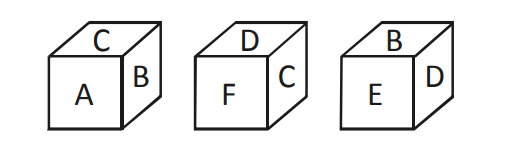
What letter comes opposite to A in the following cube ?
- A.Correct
- B.
- C.
- D.
Explanation
Tracing the given cube's net/orientation shows that the face opposite the letter A is D, based on the arrangement of the remaining labelled faces around it.
Q60General Mental Ability › Decision Making › Ethical Decision Making
As a police officer on a night round in the city you have heard the screaming of a female voice from an old building when you go closer to the building you have noticed that the doors are close and a group of people shouting inside. Then you will
- A.
enter the house forcibly and take stock of the situation.
- B.
knock the door and enquiry about the situation.
- C.
call your superiors to send some more force and permission to enter the building.
- D.
ignore that sound and complete your round.
Explanation
Standard procedure in an ambiguous but potentially volatile situation is to first calmly investigate — such as knocking and enquiring — before escalating to forced entry, which could endanger occupants or worsen the situation unnecessarily.
Q61General Mental Ability › Decision Making › Ethical Decision Making
You are discharging your duties as a special officer in a flood affected area, you have been charged by some section of the people as corrupt and made money out of it and asking the government to conduct an enquiry. Then you will
- A.
let an enquiry be conducted.
- B.
request your boss to from that transfer you from that assignment.
- C.
do not pay attention to it.
- D.
stop are relief activities until the enquiries conducted.
Explanation
Allowing a formal enquiry to proceed is the appropriate, transparent response to allegations of corruption, since it upholds accountability without pre-judging guilt or halting essential public duties like relief work.
Q62General Mental Ability › Basic Numeracy › Ratio & Proportion
A glass half full of milk weighs 700 gms. When empty it weighs 300 gms. How much will it weigh when 3/5 of it is filled with milk ?
- A.Correct
- B.
- C.
- D.
Explanation
A half-full glass (700 g) minus the empty glass's weight (300 g) shows half its milk weighs 400 g, so a completely full glass of milk weighs 800 g of milk; filling 3/5 of the glass gives 3/5 x 800 g = 480 g of milk, for a total weight of 300 g + 480 g = 780 g.
Q63General Mental Ability › Logical Reasoning › Clocks & Calendars
A bus for Bombay leaves after every forty minutes from a bus-stand. An enquiry clerk told a passenger that the bus had already left 10 minutes ago and the next bus will leave at 10.45 a.m. At what time did the enquiry clerk gave this information to the passenger ?
- A.
- B.
- C.Correct
- D.
Explanation
The next bus leaves at 10:45 a.m. and buses run every 40 minutes, so the previous bus left at 10:05 a.m.; since the clerk said that bus had already left 10 minutes earlier, the time he gave this information was 10:15 a.m.
Q64General Mental Ability › Basic Numeracy › Data Interpretation (Bar/Line/Pie Charts)
Following is the bowling speed in kmph of 4 bowlers in successive overs :
Bowler I : 135, 132, 131, 130, 134, 130
Bowler II : 90, 89, 92, 93, 91, 90
Bowler III : 118, 100, 129, 108, 125, 138
Bowler IV : 140, 140, 140, 140, 140, 140
The bowler who created more variation in the bowling speed is
- A.
- B.
- C.Correct
- D.
Explanation
Bowler III's speeds range from 100 to 138 km/h, a far wider spread than the other bowlers, whose deliveries cluster tightly or stay constant, making Bowler III's bowling speed the most variable.
Q65General Mental Ability › Basic Numeracy › Data Interpretation (Bar/Line/Pie Charts)
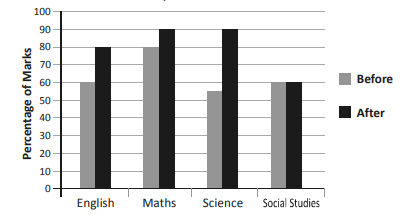
The following diagram depicts the percentage of marks scored by a student in different subjects before and after special coaching :
The gain in the percentage of marks is maximum for
- A.
- B.
- C.Correct
- D.
Explanation
This question depends on a bar/line chart referenced in the stem that is not present in this extracted data source, so the actual before-and-after percentage marks for each subject cannot be verified independently. The source retains ‘Science’ as the subject with the largest gain, and that answer is kept here as the best available judgment, but it remains an unverified, chart-dependent claim rather than a confirmed fact.
Q66Current Affairs › International News › International Relations, Treaties & Conflicts
Which of the following countries has an agreement with India to build the bullet train between Ahmedabad and Bombay ?
- A.
- B.Correct
- C.
- D.
Explanation
Japan agreed to help India build the Mumbai-Ahmedabad bullet train (high-speed rail) corridor, offering technology transfer and a long-term soft loan under a 2015-16 bilateral agreement.
Q67Current Affairs › Person in News › Sports Personalities
Which of the following pairs is not correctly matched ?
- A.
- B.Correct
- C.
- D.
Explanation
Saina Nehwal is a badminton player, not a golfer, making this pairing the incorrect one; the other three pairings — Sania Mirza-tennis, Pankaj Advani-snooker, and R. Ashwin-cricket — are all correct.
Q68Indian Polity › Constitutional & Statutory Bodies › Non-Constitutional & Statutory Bodies (NITI Aayog, NHRC, CVC, Lokpal)
Which one of the following is not correct regarding the composition of NITI Aayog ?
- A.
The Prime Minister should be Chairman
- B.
There should be Vice Chairman
- C.
Part-time members maximum 4 from leading universities research organization
- D.
There should be maximum 4 ex-officio members
Explanation
NITI Aayog's structure includes a maximum of two part-time members drawn from leading universities or research organisations, not four, so a cap of four part-time members misstates its actual composition.
Q69Applied Science & Technology › Space Technology › ISRO Missions & Programmes
The ASTROSAT launched by PSLV-C30 on September 2015 is
- A.
- B.
To provide positioning services over Indian land
- C.
A communication Satellite
- D.
To study stars and galaxies
Explanation
ASTROSAT, launched by ISRO's PSLV-C30 in September 2015, is India's first dedicated multi-wavelength space observatory, built to study celestial sources such as stars, galaxies and black holes.
Q70Current Affairs › Person in News › International Personalities
Who is the newly elected President of Italy ?
- A.
- B.
- C.Correct
- D.
Explanation
Sergio Mattarella was elected President of Italy in January 2015, succeeding Giorgio Napolitano.
Q71Current Affairs › Index, Rankings & Reports › Economic & Development Indices (GDP, HDI, MPI)
According to the World Economic Forum (WEF), who is the World's biggest employers ?
- A.
Wal-Mart : Us Super Market Giant
- B.
People's Liberation Army : Chinese Military
- C.
U.S. Department of Defence
- D.
Explanation
According to World Economic Forum data, the U.S. Department of Defense is the world's largest employer by workforce size, ahead of China's People's Liberation Army and Walmart.
Q72Physics › Energy Resources & Technology › Non-Conventional/Renewable Energy (Solar, Wind, Tidal, Geothermal)
What is Bioethanol ?
(a) It is an alcohol derived by process of fermentation mostly from carbohydrates of plant produce and feed stocks.
(b) Commonly obtained from crops such as sugarcane, cassava, corns, potato, beat root, grapes, banana and dates.
(c) It can be blended with petrol or diesel making it sustainable transport fuel.
(d) It can also be used as alternative fuel in manufacturing process and domestic product etc.
Which of the statements given above is/are correct ? Select correct answer using codes given below :
- A.
- B.
- C.
- D.Correct
Explanation
Bioethanol is an alcohol produced by fermenting carbohydrate-rich plant feedstocks such as sugarcane, corn and potatoes, and it can be blended with petrol or diesel as a transport fuel or used as an alternative industrial/domestic fuel — all the listed statements describe it accurately.
Q73Current Affairs › Index, Rankings & Reports › Economic & Development Indices (GDP, HDI, MPI)
Which of the following country top in the South Asia Region in the Human Development Index according to 2015 Global Human Development Index Report ?
- A.
- B.
- C.
- D.Correct
Explanation
In the 2015 Human Development Report, Sri Lanka held the highest HDI ranking among South Asian nations, ahead of the Maldives, India and other countries in the region.
Q74Agriculture Science › Agriculture Science › Precision Agriculture
Which of the following state is declared as fully organic farming state in India ?
- A.Correct
- B.
- C.
- D.
Explanation
Sikkim was declared India's first fully organic farming state in January 2016, having phased out chemical fertilizers and pesticides across all its cultivated land.
Q75Current Affairs › International News › Global Organisations, Summits & Alliances
Indira Gandhi Prize for Peace - 2015 awarded to
- A.Correct
- B.
- C.
- D.
Explanation
The Indira Gandhi Prize for Peace, Disarmament and Development for 2015 was awarded to the UNHCR (UN High Commissioner for Refugees) in recognition of its work supporting refugees amid the global displacement crisis.
Q76Schemes & Social Justice › Farm Schemes › Agricultural Support Schemes
The Krishi Bhagya is
(a) Karnataka Governments Flagship Scheme to achieve revolutionary change in farm sector.
(b) Government supporting for installation pumps and sprinkler irrigation system.
(c) This helps farmers to harvest surplus rain water, store effectively and efficiently irrigate crops with stored water.
(d) This scheme is mainly for assured irrigated land farmers.
Which of the statements given above is/are correct ? Select correct answer using codes given below :
- A.
- B.Correct
- C.
- D.
Explanation
Krishi Bhagya is a Karnataka government flagship scheme that helps farmers — mainly those dependent on rainfall — harvest and store surplus rainwater in farm ponds and use it efficiently through micro-irrigation such as sprinklers, and is not restricted only to farmers with assured irrigation.
Q77Karnataka Geography › Rivers & Waterfalls › Karnataka River Systems
The Guddada Mallapura Scheme is
- A.
A lift irrigation scheme of Varada River
- B.
A lift irrigation scheme of Varahi River
- C.
A lift irrigation scheme of Bhima River
- D.
A lift irrigation scheme of Karanja River
Explanation
The Guddada Mallapura Lift Irrigation Scheme draws water from the Varada River to irrigate upland areas of Karnataka that lie above the river's natural gravity-flow command.
Q78Karnataka Geography › Agriculture & Allied › Karnataka Agriculture & Allied Activities
Average size of operational holdings (As per 2010-11 Agricultural Census) in Karnataka :
- A.Correct
- B.
- C.
- D.
Explanation
As per the 2010-11 Agriculture Census, the average size of operational land holdings in Karnataka was about 1.55 hectares, reflecting the state's predominantly small and marginal farm holdings.
Q79Current Affairs › Karnataka Current Affairs › Karnataka Government Policies
Which one is not an objectives of the Minor Ports Development Policy 2014 ?
- A.
To increase the share of Karnataka State in the export and import sector, in National and International Trade and Commerce, in the post-liberalisation and globalization era.
- B.
To cater to the needs of increasing traffic of Karnataka and its neighbouring states by providing efficient facilities and services and to support the country's domestic and international trade.
- C.
To create sufficient infrastructure facilities by Government efforts to handle 5-10% of India's total cargo in Karnataka maritime waters in the days to come.
- D.
To enhance the potential of ports, with public and private participation.
Explanation
The Karnataka Minor Ports Development Policy 2014's Objectives clause (5) lists item (iii) verbatim as: ‘to create sufficient infrastructure facilities by both Government and Private efforts to handle 5-10% of India's total cargo in Karnataka Maritime waters in the days to come.’ Option (c) misquotes this by attributing the effort to ‘Government efforts’ alone, dropping the private-sector component that is central to the real objective — the 5-10% cargo figure itself is accurate, but the option's wording is not. Objectives (i), (ii) and (x) of the same policy match options (a), (b) and (d) verbatim, confirming those are genuine objectives, so (c) is correctly identified as the one that is not an objective as stated.
Q80Current Affairs › Karnataka Current Affairs › Karnataka Government Policies
Which one is not included in the strategies of Karnataka Industrial Policy 2014-19 ?
- A.
Creation of quality infrastructure with comprehensive facilities
- B.
Encourage to Micro, Small and Medium Enterprises
- C.
Special thrust for encouraging SC/ST entrepreneurs
- D.
Encourage to export and import sector.
Explanation
Karnataka's Industrial Policy 2014-19 focused on quality infrastructure, MSME promotion, and support for SC/ST entrepreneurs, but boosting exports and imports was not one of its core listed strategic thrusts.
Q81Schemes & Social Justice › Health Schemes › Health Budget Allocations
Rastriya Swastya Bima Yojana is a Government of India programme which relates to
- A.
Health Insurance Scheme for the labourers of unorganised sector.
- B.
Health Insurance Scheme for the labourers of organised sector.
- C.
Health Insurance Scheme for the labourers of organised and unorganised sector.
- D.
Financial Assistance Scheme for the labourers of organised and unorganised sector.
Explanation
The Rashtriya Swasthya Bima Yojana (RSBY) is a Government of India health insurance scheme specifically targeted at Below Poverty Line workers in the unorganised sector.
Q82Ancient & Medieval History (India) › Mauryan, Gupta & Post-Gupta India › Mauryan Empire & Ashoka
The stone Portrait of Ashoka is discovered at
- A.
- B.
- C.
- D.Correct
Explanation
A rare stone portrait sculpture identified as Emperor Ashoka was discovered at the Kanaganahalli Buddhist site in Karnataka's Kalaburagi district, one of the few surviving physical depictions of the Mauryan emperor.
Q83Karnataka History › Ancient & Medieval Karnataka Dynasties › Inscriptions, Epigraphy & Antiquity of Karnataka
Sannati is associated with which of the following religion ?
- A.Correct
- B.
- C.
- D.
Explanation
Sannati, in Karnataka's Kalaburagi district, is an important ancient Buddhist site known for its stupa remains and Ashokan-era inscriptions.
Q84Ancient & Medieval History (India) › Art, Architecture, Coinage & Trade (Ancient-Medieval) › Coinage Systems through the Ages
Of which metal were the early Punch marked coins made ?
- A.
- B.Correct
- C.
- D.
Explanation
The earliest Indian punch-marked coins, dating from around the 6th century BCE, were predominantly made of silver, stamped with punched symbols rather than cast.
Q85Ancient & Medieval History (India) › Vedic Age & Early Society › Rise of Jainism, Buddhism and Heterodox Sects
The earliest Jaina texts are written in which language ?
- A.
- B.
- C.Correct
- D.
Explanation
The earliest Jaina canonical texts (the Agamas) were composed in Ardha-Magadhi, a Prakrit dialect associated with the region where Mahavira preached.
Q86Karnataka History › Ancient & Medieval Karnataka Dynasties › Kadambas, Gangas, Chalukyas, Rashtrakutas, Hoysalas
Which one of the following Badami Chalukya King had to face the Arab invasion ?
- A.Correct
- B.
- C.
- D.
Explanation
Vikramaditya II of the Badami Chalukya dynasty (r. 733-746 CE) successfully repelled Arab incursions into the Deccan from Sindh during his reign.
Q87Indian Culture › Languages & Literature › Classical Languages and Literature (Sanskrit, Pali, Prakrit, Regional)
Jonaraja wrote the book by name
- A.Correct
- B.
- C.
- D.
Explanation
Jonaraja, a 15th-century Kashmiri court poet, wrote a continuation of Kalhana's chronicle under the same title, Rajatarangini, extending the record of Kashmiri history.
Q88Ancient & Medieval History (India) › Delhi Sultanate & Regional Kingdoms › Delhi Sultanate Dynasties and Administration
The last ruler of the Khilji dynasty to rule India was
- A.
- B.
- C.Correct
- D.
Explanation
Qutbuddin Mubarak Shah Khilji, assassinated in 1320 CE, was the last ruling sultan of the Khilji dynasty before the Tughlaqs seized power in Delhi.
Q89Karnataka History › Ancient & Medieval Karnataka Dynasties › Vijayanagara Empire and Karnataka Regional Rulers
The weavers of the Vijayanagara period were called
- A.
- B.Correct
- C.
- D.
Explanation
Weavers engaged in the flourishing textile trade of the Vijayanagara period were referred to as Kaikkolas.
Q90Karnataka History › Mysore Kingdom & Colonial Karnataka › British Commissioners' Rule & Nizam's Hyderabad-Karnataka
Which of the following missionaries played an important role in the Basel Mission in Mangalore ?
- A.
- B.
- C.
- D.Correct
Explanation
Hermann Friedrich Mogling, a Basel Mission missionary based in Mangalore, played a pioneering role in Kannada printing and journalism, notably launching Kannada's first newspaper, Mangalooru Samachara, in 1843.
Q91Karnataka History › Mysore Kingdom & Colonial Karnataka › Wodeyars, Hyder Ali & Tippu Sultan
Name the author of Modern Mysore which was published in 1936.
- A.
- B.Correct
- C.
- D.
Explanation
M. Shama Rao authored 'Modern Mysore', a two-volume historical account of the Mysore princely state, published in 1936.
Q92Karnataka History › Mysore Kingdom & Colonial Karnataka › Wodeyars, Hyder Ali & Tippu Sultan
Whose rule has been considered as the 'Golden Age of Music' in Karnataka ?
- A.
- B.
- C.Correct
- D.
Jayachamarajendra Wodeyar
Explanation
The reign of Krishnaraja Wodeyar IV (Nalvadi Krishnaraja Wodeyar) is regarded as a golden age for Karnataka's classical music and arts, owing to his extensive patronage of musicians and cultural institutions.
Q93Modern History (India) › Social & Religious Reform Movements › Caste, Depressed Classes & Backward Class Movements
'Untouchability finds no sanction in the Hindu Shastras' was said by
- A.
- B.
- C.Correct
- D.
Explanation
Mahatma Gandhi repeatedly argued that untouchability had no sanction in genuine Hindu scriptures and campaigned against it as a social evil corrupting Hindu society.
Q94Modern History (India) › Indian National Movement › Constitutional Developments (Simon Commission, Round Table, GoI Act 1935)
Cripps Mission was sent to India to seek
- A.
Co-operation of the Indians
- B.
Co-operation of the British
- C.
Co-operation of the Hindus
- D.
Co-operation of the Muslims
Explanation
The 1942 Cripps Mission was sent by the British government to secure Indian political parties' cooperation in the Allied war effort during World War II, in exchange for promised post-war dominion status.
Q95Modern History (India) › British Administration, Economic Policy & Legal Developments › British Economic Policies & Deindustrialization
The high priest of drain theory was
- A.
- B.Correct
- C.
- D.
Explanation
Dadabhai Naoroji, through his 'Drain of Wealth' theory articulated in works like Poverty and Un-British Rule in India, was the principal architect of the economic critique that British rule was systematically draining India's wealth to Britain.
Q96Modern History (India) › Indian National Movement › Constitutional Developments (Simon Commission, Round Table, GoI Act 1935)
The Viceroy who summoned the Shimla Conference was
- A.
- B.
- C.
- D.Correct
Explanation
Viceroy Lord Wavell convened the Shimla Conference in June 1945 to discuss a proposal for an interim government representing Indian political parties, though it ultimately failed over Congress-Muslim League disagreements.
Q97Physical Geography (World) › Geomorphology & Landforms › Landforms by Agent (River, Wind, Glacier, Groundwater, Coastal)
The term 'Misfit river' refers to
- A.
A broad and strait river valley which is lacking of meanders.
- B.
A big river valley with small quantity of water flowing through it.
- C.
A large river flowing in a arid region.
- D.
A small river valley in which large amount of water flows inundating the low lands.
Explanation
A misfit stream is one that appears too small for the wide, meandering valley it occupies, indicating the valley was originally carved by a far greater volume of water than the present, diminished river now carries.
Q98Physical Geography (World) › Geomorphology & Landforms › Landforms by Agent (River, Wind, Glacier, Groundwater, Coastal)
Playa lakes are one of the typical features in the
- A.
- B.
- C.Correct
- D.
Explanation
Playa lakes are shallow, temporary salt lakes typical of desert basins, forming when intermittent rainfall or runoff collects in enclosed depressions and then evaporates rapidly.
Q99Physical Geography (World) › Geomorphology & Landforms › Interior of the Earth, Rocks & Earthquakes
Identify the best explanation of Igneous rocks.
- A.
Primary rocks formed by cooling of lava, crystalline and lacking of fossils.
- B.
Primary rocks formed by cooling of lava, lacking of crystals of any size and are known for the deposits of coal and petroleum.
- C.
Igneous rocks are formed both on the surface of the earth and underground but do not have any kind of minerals except coal.
- D.
Primary rocks and these are porous known for large amount of underground water.
Explanation
Igneous rocks are primary rocks formed directly from the cooling and solidification of molten lava or magma; being crystalline in structure, they do not contain fossils, unlike sedimentary rocks.
Q100Physical Geography (World) › Climatology & Atmosphere › Atmospheric Structure, Pressure & Winds
Most of the weather phenomena is confined to
- A.Correct
- B.
- C.
- D.
Explanation
Nearly all everyday weather phenomena — clouds, rain, storms — occur in the troposphere, the lowest atmospheric layer, where temperature decreases with altitude and most water vapour and convective activity are concentrated.