Q1Ancient & Medieval History (India) › Regional & South Indian Dynasties › Cholas, Pallavas, Pandyas, Chalukyas, Rashtrakutas
Who was the founder of Chalukya of Badami ?
- A.
- B.
- C.Correct
- D.
Explanation
Pulakesin I founded the Chalukya dynasty of Badami in the 6th century CE, establishing Vatapi (Badami) as its capital.
Q2Ancient & Medieval History (India) › Mauryan, Gupta & Post-Gupta India › Gupta Empire (Golden Age) & Harshavardhana
Who was the Chinese Buddhist pilgrim who visited Harsha empire ?
- A.
- B.
- C.Correct
- D.
Explanation
Hieun Tsang (Xuanzang) was the Chinese Buddhist pilgrim who travelled to India during the reign of Harsha Vardhana and recorded detailed accounts of his empire.
Q3Current Affairs › Karnataka Current Affairs › Karnataka Government Policies
Ksheer Bhagya scheme is implemented in which state ?
- A.
- B.Correct
- C.
- D.
Explanation
Ksheera Bhagya is a scheme launched by the Government of Karnataka to provide milk to schoolchildren to improve their nutrition.
Q4Ancient & Medieval History (India) › Prehistoric Era & Indus Valley Civilization › Harappan Civilization: Society, Economy, Decline
How many granaries are found in Harappa ?
- A.
- B.
- C.Correct
- D.
Explanation
Archaeological excavations at Harappa have revealed six granaries, which were used for grain storage in the Indus Valley Civilization.
Q5Current Affairs › Person in News › Cultural, Literary & Social Figures
Bhupinder Singh, who recently passed away, was a famous personality in which field?
- A.
- B.Correct
- C.
- D.
Explanation
Bhupinder Singh was a renowned Indian playback singer known for his ghazals and film songs.
Q6Physical Geography (World) › Geomorphology & Landforms › Miscellaneous
Palaeontology is related with ________.
- A.
- B.
- C.Correct
- D.
Explanation
Palaeontology is the scientific study of fossils to understand the history of life on Earth.
Q7Applied Science & Technology › Information & Communication Technology › Miscellaneous
What is the full form of GSM?
- A.
Geographic System for Mobile
- B.
- C.
Geographic Special Mobile
- D.Correct
Explanation
GSM stands for Global System for Mobile Communications, a standard for mobile telephony.
Q8Current Affairs › Person in News › Sports Personalities
Which sport’s professional tournament is “The Evian Championship”?
- A.
- B.Correct
- C.
- D.
Explanation
The Evian Championship is one of the major professional women's golf tournaments, part of the LPGA Tour majors.
Q9Ancient & Medieval History (India) › Mauryan, Gupta & Post-Gupta India › Post-Mauryan Foreign Dynasties (Indo-Greeks, Kushanas, Satavahanas)
Which one of the following pairs is correctly mapped?
- A.
Harappan Civilisation - Painted grey ware
- B.
The Kushans - Gandhara school of art
- C.
The Mughals - Ajanta Paintings
- D.
The Marathas - Pahari school of painting
Explanation
The Kushans patronized the Gandhara school of art, which blended Greco-Roman and Indian artistic styles in Buddhist sculpture.
Q10Modern History (India) › British Administration, Economic Policy & Legal Developments › Miscellaneous
Who is called the father of local self government?
- A.
- B.
- C.Correct
- D.
Explanation
Lord Ripon is regarded as the father of local self-government in India for his 1882 resolution promoting local bodies.
Q11Modern History (India) › British Administration, Economic Policy & Legal Developments › Charter Acts, Council Acts & Government of India Acts
Arrange the Chronological Order: 1. Indian Penal Code 2. East India Association 3. Vernacular Press Act 4. Ilbert Bill. Select the appropriate option.
- A.Correct
- B.
- C.
- D.
Explanation
The chronological order is: Indian Penal Code (1860), East India Association (1866), Vernacular Press Act (1878), Ilbert Bill (1883), corresponding to sequence 1, 2, 3, 4.
Q12Current Affairs › Person in News › International Personalities
Justin Trudeau is the Prime Minister of which country?
- A.
- B.Correct
- C.
- D.
Explanation
Justin Trudeau has served as the Prime Minister of Canada.
Q13Economy › Industry & Manufacturing › Industrial Classification
"Sugarcane bagasse pulp" is the main raw material for manufacturing of following product.
- A.
- B.Correct
- C.
- D.
Explanation
Sugarcane bagasse pulp is widely used as a raw material for manufacturing paper, serving as an eco-friendly alternative to wood pulp.
Q14Economic Geography (India) › Industry & Transport › Transport Networks (Rail, Road, Water, Air, Pipelines)
Which of the following is not a major port?
- A.
- B.
- C.Correct
- D.
Explanation
Malpe is a fishing harbour in Karnataka and not classified as a major port, unlike Kandla, Paradeep, and Tuticorin which are major ports of India.
Q15Indian Polity › Constitutional Amendments › Amendment Bills
Which of the following amendment facilitated the appointment of the same person as a governor for two or more states?
- A.Correct
- B.
- C.
- D.
Explanation
The 7th Constitutional Amendment Act, 1956, enabled the appointment of the same person as governor for two or more states.
Q16Karnataka Geography › Physiography › Miscellaneous
Karavali Karnataka is affected by which of the following natural disasters?
i. Floods
ii. Cyclones
iii. Landslides
iv. Sea erosion
- A.
- B.
- C.
- D.Correct
Explanation
Karavali (coastal) Karnataka is prone to floods, cyclones, landslides, and sea erosion due to its coastal and high-rainfall geography.
Q17Karnataka Geography › Physiography › Miscellaneous
Which of the following ghats connects Chikamagaluru with Mangaluru?
- A.
- B.
- C.Correct
- D.
Explanation
Charmadi Ghat is the mountain pass that connects Chikkamagaluru with Mangaluru through the Western Ghats.
Q18Karnataka History › Mysore Kingdom & Colonial Karnataka › Miscellaneous
Mysore state established the Mysore Iron and Steel Works at Bhdravathi in the year
- A.Correct
- B.
- C.
- D.
Explanation
The Mysore Iron and Steel Works was established at Bhadravathi in 1923 by the Mysore state under Diwan M. Visvesvaraya.
Q19Karnataka Geography › Physiography › Miscellaneous
Which of following hills located in Karnataka is one of the biggest 'monolith hill' in Asia?
- A.Correct
- B.
- C.
- D.
Explanation
Madhugiri Hill in Karnataka is regarded as one of the largest single (monolith) rock hills in Asia.
Q20Geography of India › Soils & Natural Vegetation › Soil Types and Conservation
Following description describes which soil?
"This type of soil is obtained from the weathering of granite and gneiss. It contains iron oxides. It is rich in iron, lime and salt, but contains small amounts of humus. It is light, has thin layers and it is not very fertile. Its capacity to moisture retention is less."
- A.Correct
- B.
- C.
- D.
Explanation
Red soil forms from the weathering of granite and gneiss, is rich in iron oxide but low in humus, and has low moisture retention capacity.
Q21Karnataka Geography › Rivers & Waterfalls › Famous Waterfalls
Gokak falls is created by which river?
- A.
- B.
- C.Correct
- D.
Explanation
Gokak Falls is formed by the Ghataprabha River in Karnataka.
Q22Karnataka Geography › Rivers & Waterfalls › Karnataka River Systems
Kudalasangama is the confluence of which two rivers ?
- A.
- B.Correct
- C.
- D.
Explanation
Kudalasangama is the sacred confluence of the Malaprabha and Krishna rivers in Karnataka, associated with the saint Basaveshwara.
Q23Geography of India › Physiography, Climate & Drainage › River Systems and Drainage Patterns
Which of the following is not the west flowing river ?
- A.
- B.
- C.Correct
- D.
Explanation
The Pennar (Penna) river flows eastward into the Bay of Bengal, unlike Sharavathi, Kali, and Varahi which are west-flowing rivers of Karnataka.
Q24Karnataka Geography › Agriculture & Allied › Karnataka Agriculture & Allied Activities
Which district of Karnataka has the largest area under canal irrigation in the state ?
- A.
- B.
- C.Correct
- D.
Explanation
Raichur district in Karnataka has the largest area under canal irrigation, benefiting from the Krishna and Tungabhadra river projects.
Q25Karnataka Geography › Physiography › Biodiversity Regions
Which of the following are the Tiger projects ?
i. Bandipura
ii. Bhadra
iii. Nagarahole
iv. Ansi
v. Kudremukh
- A.
- B.
- C.Correct
- D.
Explanation
Bandipur, Bhadra, and Nagarahole are notified Tiger Reserves (Project Tiger) in Karnataka, while Anshi and Kudremukh are primarily known as national parks/biosphere reserves rather than core tiger projects in this list.
Q26Karnataka Geography › Rivers & Waterfalls › Karnataka River Systems
What is the correct sequence of rivers in Karnataka from North to South ?
- A.
Bhima, Krishna, Tungabhadra, Vedavathi
- B.
Bhima, Krishna, Vedavathi, Tungabhadra
- C.
Bhima, Vedavathi, Krishna, Tungabhadra
- D.
Bhima, Tungabhadra, Krishna, Vedavathi
Explanation
From North to South, the rivers of Karnataka occur in the sequence Bhima, Krishna, Tungabhadra, and Vedavathi.
Q27Karnataka Geography › Rivers & Waterfalls › Karnataka River Systems
Basava Sagar (Narayanpura Dam) is built across which river ?
- A.
- B.Correct
- C.
- D.
Explanation
Basava Sagar Dam (Narayanpur Dam) is constructed across the Krishna River in Karnataka.
Q28Geography of India › Physiography, Climate & Drainage › River Systems and Drainage Patterns
Teesta river originates in which state of India ?
- A.
- B.
- C.Correct
- D.
Explanation
The Teesta River originates in Sikkim, from the Tso Lhamo Lake near the Tibet border.
Q29Karnataka Geography › Agriculture & Allied › Karnataka Agriculture & Allied Activities
Which district is known as granary of Togari (Toor) ?
- A.Correct
- B.
- C.
- D.
Explanation
Kalaburagi district is known as the granary of Togari (Toor dal/pigeon pea) due to its extensive cultivation there.
Q30Chemistry › Basic Chemical Concepts › Acids, Bases & Salts
Consider the following statements about pH scale :
i. A scale for measuring hydrogen ion concentration in a solution.
ii. Our body works within the pH range of 7.0 to 7.8.
iii. pH value 7 stands for neutral solution, 14 stands for very alkaline and 0 stands for very acidic solution.
Which of the above statements are correct ?
- A.Correct
- B.
- C.
- D.
Explanation
The pH scale measures hydrogen ion concentration, with 7 as neutral, values above 7 alkaline (14 being most alkaline) and below 7 acidic (0 most acidic), and the human body functions within a pH range of approximately 7.0 to 7.8, making all three statements correct.
Q31Chemistry › Metals, Alloys & Materials › Common Alloys
Which of the following metals is used for galvanizing steel ?
- A.Correct
- B.
- C.
- D.
Explanation
Zinc is used to coat steel in the galvanization process to prevent rusting through a sacrificial anode effect.
Q32Karnataka Geography › Physiography › Miscellaneous
Which of the following districts share border with Kerala state ?
- A.
- B.
Dakshina Kannada, Kodagu, Mysuru
- C.
Dakshina Kannada, Kodagu, Mysuru, Chamarajanagar
- D.
Explanation
Dakshina Kannada, Kodagu, Mysuru, and Chamarajanagar districts of Karnataka share a border with Kerala.
Q33Physical Geography (World) › Climatology & Atmosphere › Atmospheric Structure, Pressure & Winds
Which of the following is not greenhouse gas ?
- A.
- B.
- C.
- D.Correct
Explanation
Sulphur Dioxide (SO2) is a pollutant causing acid rain but is not classified as a greenhouse gas, unlike CO2, CH4, and N2O.
Q34Biology › Human Physiology & Systems › Miscellaneous
The following medical scan is an imaging test that uses radioactive substance called tracer to look for disease in the body:
- A.
- B.
- C.Correct
- D.
Explanation
A PET (Positron Emission Tomography) scan uses a radioactive tracer substance to detect disease activity in the body.
Q35Biology › Human Physiology & Systems › Miscellaneous
Growth hormone is secreted by which gland?
- A.
- B.
- C.Correct
- D.
Explanation
Growth hormone (somatotropin) is secreted by the pituitary gland, located at the base of the brain.
Q36Environment › Ecology & Ecosystem › Food Web & Energy Transfer
The phenomenon of increase in the concentration of some substances e.g. pesticides as we go up the food chain across trophic levels, is called
- A.Correct
- B.
- C.
- D.
Explanation
Biomagnification is the process where the concentration of substances like pesticides increases progressively at higher trophic levels of a food chain.
Q37Physical Geography (World) › Climatology & Atmosphere › Atmospheric Structure, Pressure & Winds
Consider the following statements about Ozone :
i. Ozone (O3) is a molecule formed by three atoms of oxygen.
ii. Like Oxygen, ozone is essential for all aerobic forms of life.
iii. Ozone shields the surface of the earth from Ultra Violet (UV) radiation from the Sun.
Which of the above statements are correct?
- A.
- B.
- C.Correct
- D.
Explanation
Ozone (O3), composed of three oxygen atoms, shields the Earth's surface from harmful ultraviolet radiation, though unlike oxygen it is not essential for aerobic respiration and is toxic at ground level, making statements i and iii correct.
Q38Physics › Electricity & Magnetism › Electromagnetic Induction
- A.
Electromagnetic Induction
- B.
- C.
Relation between voltage, current and resistance
- D.
Explanation
Faraday's laws of electromagnetic induction describe how a changing magnetic field induces an electromotive force in a conductor.
Q39Chemistry › Basic Chemical Concepts › Atomic Structure & Periodic Table
Which of the following is an inert gas?
- A.
- B.
- C.Correct
- D.
Explanation
Argon is a noble (inert) gas, chemically unreactive due to its complete outer electron shell, unlike nitrogen, fluorine, and chlorine.
Q40Biology › Genetics & Biotechnology › Basics of Genetics & DNA
Human DNA consists of how many chromosome pairs? Which chromosome pair determines sex?
- A.
23 pairs, 23rd pair determines sex
- B.
22 pairs, 22nd pair determines sex
- C.
23 pairs, 22nd pair determines sex
- D.
22 pairs, 21st pair determines sex
Explanation
Human DNA is organized into 23 pairs of chromosomes, and the 23rd pair (X and Y chromosomes) determines the sex of an individual.
Q41Biology › Diseases › Nutritional Diseases & Vitamin Deficiencies
Vitamin D deficiency can lead to which disease in children?
- A.
- B.Correct
- C.
- D.
Explanation
Vitamin D deficiency in children causes Rickets, a condition marked by soft and weak bones due to poor calcium absorption.
Q42Biology › Genetics & Biotechnology › Miscellaneous
The book “Origin of species” is written by whom?
- A.
- B.
- C.
- D.Correct
Explanation
'On the Origin of Species' was written by Charles Darwin, presenting his theory of evolution by natural selection.
Q43Physics › Mechanics & Motion › Miscellaneous
Match the scientists with the theories propounded by them : 1. Einstein - A. Law of Buoyancy 2. Newton - B. Theory of relativity 3. Archimedes - C. Laws of motion
- A.Correct
- B.
- C.
- D.
Explanation
Einstein propounded the Theory of Relativity, Newton formulated the Laws of Motion, and Archimedes discovered the Law of Buoyancy, matching 1-B, 2-C, 3-A.
Q44Applied Science & Technology › Information & Communication Technology › Miscellaneous
The term “Man in the middle attack” is normally used in which context?
- A.
- B.
- C.Correct
- D.
Explanation
A 'Man in the middle attack' is a term used in cyber security, referring to an attacker secretly intercepting communication between two parties.
Q45Chemistry › Metals, Alloys & Materials › Miscellaneous
The property of metals being drawn into wire without breaking is called
- A.Correct
- B.
- C.
- D.
Explanation
Ductility is the property of metals that allows them to be drawn into thin wires without breaking.
Q46Biology › Diseases › Nutritional Diseases & Vitamin Deficiencies
"Colour blindness" may be caused by deficiency of
- A.Correct
- B.
- C.
- D.
Explanation
Colour blindness is largely a genetic condition, but Vitamin A deficiency affects vision (as in night blindness) and is commonly linked with visual impairment in this context.
Q47Biology › Human Physiology & Systems › Skeletal System & Calcium
Which is the longest bone in our body
- A.
- B.Correct
- C.
- D.
Explanation
The femur (thigh bone) is the longest and strongest bone in the human body.
Q48Biology › Genetics & Biotechnology › Basics of Genetics & DNA
In a family, one child has blue eyes like the mother and the other child has brown hair like the father. This phenomenon can be attributed to
- A.
- B.
- C.Correct
- D.
Explanation
Children inheriting physical traits such as eye colour or hair colour from their parents is an example of heredity, the passing of genetic characteristics from parents to offspring.
Q49General Mental Ability › Basic Numeracy › Miscellaneous
A can do a piece of work in 18 days. A does the work for 6 days only and leaves the job. B does the remaining work in 8 days. In how many days can B alone do the work?
- A.Correct
- B.
- C.
- D.
Explanation
A does 6/18 = 1/3 of the work in 6 days, leaving 2/3 of the work for B to complete in 8 days; thus B alone completes the full work in 8 × 3/2 = 12 days.
Q50General Mental Ability › Basic Numeracy › Numbers & Number Systems
What is the number in place of question mark?
- A.
- B.Correct
- C.
- D.
Explanation
In each row, column 2 = (column 1)² + 1 [2²+1=5, 4²+1=17, 5²+1=26 — all verified] and column 3 = (column 1)³ + 2 [2³+2=10, 4³+2=66 — both verified]; applying the same rule to row 3: 5³+2 = 125+2 = 127.
Q51General Mental Ability › Logical Reasoning › Coding-Decoding
What should come in the place of question marks (?) in the following series?
E-5, G-7, I-9, K-11, ?, ?
- A.
- B.Correct
- C.
- D.
Explanation
The series follows alternate letters (E, G, I, K, M, O — skipping one letter each time) with corresponding odd numbers (5, 7, 9, 11, 13, 15), giving M-13 and O-15.
Q52General Mental Ability › Basic Numeracy › Miscellaneous
A man ate 120 bananas in five days, each day eating 6 more than the previous day. How many bananas did he eat on the first day?
- A.
- B.
- C.Correct
- D.
Explanation
Let the first day's count be x; the sum of an arithmetic sequence of 5 terms with common difference 6 is 5x + 60 = 120, giving x = 12.
Q53General Mental Ability › Basic Numeracy › Miscellaneous
If x - 2y = 4 then 3x - 6y = ?
- A.
- B.Correct
- C.
- D.
Explanation
Multiplying the equation x - 2y = 4 by 3 on both sides gives 3x - 6y = 12.
Q54General Mental Ability › Logical Reasoning › Coding-Decoding
If TIME = 5461, MAT = 625, EARTH = 12758, then HEART =
- A.
- B.Correct
- C.
- D.
Explanation
Comparing the coded words letter by letter: TIME=5461 gives T=5, I=4, M=6, E=1; MAT=625 gives M=6, A=2, T=5 (T and M match TIME, confirming the code); EARTH=12758 gives E=1, A=2, R=7, T=5, H=8 (E, A, T all match earlier values). So H=8, E=1, A=2, R=7, T=5, and HEART = 8-1-2-7-5 = 81275.
Q55General Mental Ability › Basic Numeracy › Numbers & Number Systems
The next number in the series : 1, 9, 25, 57, 121, ? (2x + 7)
- A.
- B.
- C.Correct
- D.
Explanation
The series follows the rule that each term is obtained using 2x + 7 applied progressively: 1, 9, 25, 57, 121, 249, since 121×2+7 = 249.
Q56General Mental Ability › Basic Numeracy › Miscellaneous
The sum of two numbers is 25 and their difference is 9. Find sum of their squares.
- A.
- B.
- C.Correct
- D.
Explanation
If the two numbers are a and b with a+b=25 and a-b=9, then a=17 and b=8; sum of squares = 17² + 8² = 289 + 64 = 353.
Q57General Mental Ability › Logical Reasoning › Direction & Distance
Ramesh moves towards South-east a distance of 10 m, then he moves towards West and travels a distance of 14 m. From here, he moves towards North-east a distance of 10 m and then he moves a distance of 6 m towards East and stood at the point. How far is the starting point from where he stood?
- A.
- B.
- C.Correct
- D.
Explanation
The two diagonal legs (10 m South-East, then 10 m North-East) each split into roughly 7 m East and 7 m North/South; the South component of the first leg cancels the North component of the second, so together they contribute about 14 m East. This 14 m East exactly cancels the 14 m West leg, leaving only the final 6 m East move as the net displacement — so the finishing point is 6 m from the starting point.
Q58General Mental Ability › Basic Numeracy › Trains Problems
A train running at a speed of 30 m/s crosses a pole in 15 sec less than the time it requires to cross a bridge 4 times its length at the same speed. What is the length of the bridge?
- A.
- B.
- C.
- D.Correct
Explanation
Let the train's length be x, so the bridge length is 4x. Time to cross the pole = x/30 sec; time to cross the bridge = 4x/30 sec. Since the bridge takes 15 sec more: 4x/30 − x/30 = 15 → 3x/30 = 15 → x = 150 m. So the bridge length = 4 × 150 = 600 m.
Q59General Mental Ability › Basic Numeracy › Miscellaneous
A certain job was assigned to a group of men to do in 24 days. But 8 men did not turn up for the job and the remaining men did the job in 32 days. The original number of men in the group was
- A.Correct
- B.
- C.
- D.
Explanation
Using the work equation where the full group completes the job in 24 days and (x-8) men complete it in 32 days, solving 24x = 32(x-8) gives x = 32 men originally.
Q60General Mental Ability › Basic Numeracy › Percentage
A bus full of passengers started from point A. At point B, 20 % of the passengers got down. Further at point C, 40 % of the remaining passengers got down. Now the bus has 24 passengers remaining. How many passengers were in the bus when it started?
- A.Correct
- B.
- C.
- D.
Explanation
If the bus started with x passengers, after 20% got down 0.8x remained, and after 40% of that got down, 0.6×0.8x = 0.48x remained; setting 0.48x = 24 gives x = 50.
Q61General Mental Ability › Basic Numeracy › Ratio & Proportion
The average age of three men is 12 years. If their ages are in ratio of 2:3:4, the age of the youngest boy is
- A.Correct
- B.
- C.
- D.
Explanation
The total age is 12×3=36 years, and dividing in ratio 2:3:4 (9 parts) gives the youngest share as (2/9)×36 = 8 years.
Q62General Mental Ability › Basic Numeracy › Miscellaneous
When two dice are rolled together, what is the probability of getting a sum of 3?
- A.
- B.
- C.Correct
- D.
Explanation
Rolling two dice, the outcomes summing to 3 are (1,2) and (2,1), giving 2 favorable outcomes out of 36 total, i.e., probability 2/36 = 1/18.
Q63Current Affairs › Person in News › Sports Personalities
Who won ICC World Test Championship 2023?
- A.
- B.Correct
- C.
- D.
Explanation
Australia won the ICC World Test Championship 2023 final, defeating India at The Oval.
Q64General Mental Ability › Logical Reasoning › Miscellaneous
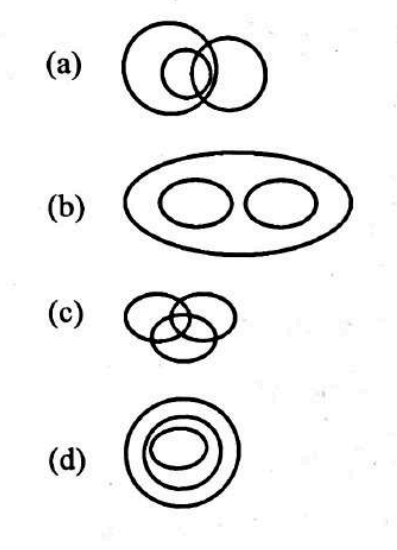
Which of the following diagram describes the relation between men, fathers, doctors?
- A.Correct
- B.
- C.
- D.
Explanation
Logically, every father is a man, so the 'fathers' circle should sit entirely inside the 'men' circle. 'Doctors', however, is an independent profession open to both men and women, so the 'doctors' circle should only partly overlap the 'men' circle, and it can also partly overlap the 'fathers' circle (since a man can be both a father and a doctor). Diagram (a) is the one that correctly shows this combination of full and partial overlaps; refer to the accompanying image for the exact figure.
Q65Indian Polity › Judiciary › Supreme Court, High Courts & Judicial Review
The Union Territory that has a High Court of its own is
- A.Correct
- B.
- C.
- D.
Explanation
Delhi, though a Union Territory, has its own High Court (Delhi High Court), unlike most other Union Territories which fall under the jurisdiction of neighbouring state High Courts.
Q66Indian Polity › Fundamental Rights, DPSP & Duties › Fundamental Rights and Landmark Caselaws
Who is considered as guardian of Fundamental Rights in India?
- A.
- B.Correct
- C.
- D.
Explanation
The Supreme Court of India is regarded as the guardian and protector of the Fundamental Rights guaranteed under the Constitution.
Q67Indian Polity › Local Government › Panchayati Raj (73rd Amendment)
Panchayat Raj was 1st established in
- A.
- B.
- C.Correct
- D.
Explanation
Panchayati Raj was first established in Rajasthan in 1959, at Nagaur, following the recommendations of the Balwant Rai Mehta Committee.
Q68Indian Polity › Judiciary › Supreme Court, High Courts & Judicial Review
The Judges of the Supreme Court are appointed by
- A.
- B.
- C.Correct
- D.
Explanation
Judges of the Supreme Court of India are appointed by the President of India as per Article 124 of the Constitution.
Q69Indian Polity › Fundamental Rights, DPSP & Duties › Directive Principles of State Policy & Fundamental Duties
Fundamental Duties were incorporated in the constitution based on the recommendation of __________ committee.
- A.Correct
- B.
- C.
- D.
Explanation
Fundamental Duties were added to the Indian Constitution by the 42nd Amendment Act (1976) based on the recommendations of the Swaran Singh Committee.
Q70Modern History (India) › Indian National Movement › Early Nationalism, Swadeshi & Home Rule
Lucknow Pact was held between-
- A.
Hindu Mahasabha and Muslim League
- B.
- C.
Indian National Congress and Muslim League
- D.
Moderates and Muslim League
Explanation
The Lucknow Pact of 1916 was an agreement between the Indian National Congress and the Muslim League for constitutional reforms and Hindu-Muslim unity.
Q71Modern History (India) › Indian National Movement › Revolutionary Movements & the INA
Which of the following leader wrote the book 'The Indian War of Independence'?
- A.Correct
- B.
- C.
- D.
Explanation
Vinayak Damodar Savarkar wrote the book 'The Indian War of Independence', presenting the 1857 revolt as India's first war of independence.
Q72Indian Polity › Constitutional & Statutory Bodies › Non-Constitutional & Statutory Bodies (NITI Aayog, NHRC, CVC, Lokpal)
The Chairperson and other members of State Human Rights Commission are appointed by the
- A.Correct
- B.
- C.
- D.
Explanation
The Chairperson and members of the State Human Rights Commission are appointed by the Governor of the state.
Q73Modern History (India) › Indian National Movement › Miscellaneous
Arrange the Chronological Order with respect to Tribal and Peasant Movement : 1. Munda Uprisings 2. Bhil Uprising 3. Ramosi Uprising 4. Kol Uprising
- A.
- B.Correct
- C.
- D.
Explanation
As per the sequence tested, the order is Bhil Uprising, Munda Uprising, Ramosi Uprising, and Kol Uprising, i.e., 2, 1, 3, 4. These tribal and peasant revolts against colonial exploitation occurred at different points across the 19th century, and candidates should cross-check the exact years against their study material since some of these uprisings (like the Bhil and Kol revolts) recurred in multiple phases.
Q74Biology › Genetics & Biotechnology › Miscellaneous
The basic unit of Protein is
- A.
- B.Correct
- C.
- D.
Explanation
Amino acids are the basic structural units (building blocks) of proteins, linked together by peptide bonds.
Q75Ancient & Medieval History (India) › Mauryan, Gupta & Post-Gupta India › Gupta Empire (Golden Age) & Harshavardhana
The founder of Nalanda University
- A.
- B.Correct
- C.
- D.
Explanation
Kumaragupta I of the Gupta dynasty is credited with founding Nalanda University in the 5th century CE.
Q76Modern History (India) › Social & Religious Reform Movements › Reform Movements and Reformers (19th–20th Century)
In India, who started the Wahabi Movement ?
- A.
Sayyid Ahmad of Rae Bareli
- B.
- C.
- D.
Explanation
Sayyid Ahmad of Rae Bareli started the Wahabi Movement in India, an Islamic reformist and anti-British movement in the 19th century.
Q77Biology › Animal Biology › Miscellaneous
- A.
The Botanical Survey of India and Zoological Survey of India
- B.
The Botanical Service of India and Zoological Service of India
- C.
The Basic Survey of India and Zonary Survey of India
- D.
The Basic Service of India and Zonary Service of India
Explanation
BSI and ZSI stand for the Botanical Survey of India and the Zoological Survey of India, the premier government institutions for flora and fauna research.
Q78Chemistry › Metals, Alloys & Materials › Plaster of Paris & Building Materials
- A.
- B.
- C.
- D.Correct
Explanation
Plaster of Paris is chemically calcium sulphate hemihydrate, represented as CaSO4 · 1/2H2O.
Q79Modern History (India) › British Administration, Economic Policy & Legal Developments › Miscellaneous
The Governor General of India who initiated the introduction of English in India was
- A.
- B.
- C.
- D.Correct
Explanation
Lord William Bentinck, as Governor-General of India, introduced English education in India based on Macaulay's Minute of 1835.
Q80Biology › Cell Biology › Miscellaneous
Which among the following is called as borderline/ connecting link between the plants and animals ?
- A.Correct
- B.
- C.
- D.
Explanation
Euglena is regarded as a connecting link between plants and animals since it exhibits characteristics of both, such as photosynthesis and animal-like locomotion.
Q81Indian Culture › Miscellaneous Culture › Cultural Heritage Sites, Handicrafts & Awards
"Sacred Ensembles of the Hoysala", the nomination for World Heritage List, are located in which state?
- A.
- B.Correct
- C.
- D.
Explanation
The 'Sacred Ensembles of the Hoysala' UNESCO World Heritage nomination, comprising temples like Belur, Halebidu, and Somanathapura, is located in Karnataka.
Q82Biology › Animal Biology › Miscellaneous
Little Bloodtail, which is considered as a harbinger of monsoon, belongs to which type of species?
- A.
- B.Correct
- C.
- D.
Explanation
The Little Bloodtail, a species of dragonfly, is considered a harbinger of the monsoon in India as it appears in large numbers just before the rains.
Q83Applied Science & Technology › Space Technology › World Space Missions
"Tianzhou-2" is a spacecraft of which country?
- A.
- B.
- C.Correct
- D.
Explanation
Tianzhou-2 is a Chinese cargo spacecraft used to resupply China's space station.
Q84Economy › Infrastructure & Investment › Logistics Policy
'SAGAR SAMRIDDHI' is an initiative of which Union Ministry?
- A.
- B.
- C.
Ministry of Ports, Shipping and Waterway
- D.
Ministry of External Affairs
Explanation
Sagar Samriddhi is an initiative of the Ministry of Ports, Shipping and Waterways aimed at cleaning India's coastline and reducing marine litter.
Q85Modern History (India) › Freedom Struggle Personalities › Key Freedom Fighters, Viceroys & Governors General
Who gave the title of Sardar to Vallabhbhai Patel ?
- A.
- B.Correct
- C.
- D.
Explanation
Mahatma Gandhi conferred the title 'Sardar' upon Vallabhbhai Patel in recognition of his leadership during the Bardoli Satyagraha.
Q86Modern History (India) › Indian National Movement › Constitutional Developments (Simon Commission, Round Table, GoI Act 1935)
Who among the following was not a member of The British Cabinet mission which came to India in March 1946 ?
- A.
- B.
- C.
- D.Correct
Explanation
The 1946 British Cabinet Mission to India comprised Pethick-Lawrence, Stafford Cripps, and A.V. Alexander; Campbell Johnson was not a member of this mission.
Q87Indian Polity › Legislature › Parliament: Composition, Powers & Procedure
Who is the speaker of the first Lok Sabha ?
- A.
- B.Correct
- C.
- D.
Explanation
G.V. Mavalankar was the first Speaker of the Lok Sabha (Independent India's House of the People).
Q88Geography of India › Physiography, Climate & Drainage › Physiographic Divisions of India
Loktak Lake, the largest freshwater lake in India, is located in which state ?
- A.
- B.Correct
- C.
- D.
Explanation
Loktak Lake, the largest freshwater lake in Northeast India, is located in Manipur.
Q89Indian Culture › Religions & Philosophy of India › Hinduism, Buddhism, Jainism and their Philosophy
The concept of Anuvrata was advocated by
- A.
- B.
- C.Correct
- D.
Explanation
The concept of Anuvrata (minor vows for lay followers) was advocated by Jainism as a practical version of the Mahavratas followed by monks.
Q90Indian Polity › Constitutional Amendments › Amendment Bills
By which of the following amendments was the Right to Property deleted from the list of Fundamental Rights ?
- A.
- B.
- C.Correct
- D.
Explanation
The 44th Constitutional Amendment Act, 1978, removed the Right to Property from the list of Fundamental Rights, making it a legal right under Article 300A instead.
Q91Indian Polity › Fundamental Rights, DPSP & Duties › Directive Principles of State Policy & Fundamental Duties
The Articles of Constitution which deal with Directive Principles of State Policy are
- A.
- B.
- C.Correct
- D.
Explanation
The Directive Principles of State Policy are enshrined in Articles 36 to 51 of Part IV of the Indian Constitution.
Q92Modern History (India) › Indian National Movement › Miscellaneous
Who was the President of the Indian Congress during the Lahore session of 1929 ?
- A.
- B.
- C.Correct
- D.
Explanation
Jawaharlal Nehru presided over the Lahore session of the Indian National Congress in 1929, which passed the historic Purna Swaraj resolution.
Q93Indian Polity › Constitutional & Statutory Bodies › Constitutional Bodies (Election Commission, CAG, UPSC, Finance Commission)
Who advises the Government of India on legal matters ?
- A.Correct
- B.
Chief Justice of Supreme Court
- C.
- D.
Explanation
The Attorney General of India is the chief legal advisor to the Government of India on legal matters.
Q94Modern History (India) › Social & Religious Reform Movements › Reform Movements and Reformers (19th–20th Century)
In which year did Swami Vivekananda participate in the World Parliament at Chicago ?
- A.Correct
- B.
- C.
- D.
Explanation
Swami Vivekananda represented India at the World's Parliament of Religions in Chicago in 1893.
Q95Modern History (India) › Social & Religious Reform Movements › Reform Movements and Reformers (19th–20th Century)
Which among the following was a newspaper founded and edited by Raja Ram Mohan Roy ?
- A.
- B.Correct
- C.
- D.
Explanation
Mirat-ul-Akhbar was a Persian-language newspaper founded and edited by Raja Ram Mohan Roy.
Q96Ancient & Medieval History (India) › Vedic Age & Early Society › Rise of Jainism, Buddhism and Heterodox Sects
Who presided over the first Buddhist council ?
- A.Correct
- B.
- C.
- D.
Explanation
Mahakassapa (Mahakashyapa) presided over the First Buddhist Council held at Rajgriha shortly after the Buddha's death.
Q97Ancient & Medieval History (India) › Mauryan, Gupta & Post-Gupta India › Gupta Empire (Golden Age) & Harshavardhana
Which one of the following was the official language of Gupta period ?
- A.
- B.
- C.
- D.Correct
Explanation
Sanskrit was the official court language during the Gupta period, used extensively in literature and inscriptions.
Q98Indian Culture › Architecture & Sculpture › Ancient & Medieval Temple Architecture
The Sun temple of Modhera lies in which state ?
- A.
- B.Correct
- C.
- D.
Explanation
The Sun Temple of Modhera, built by the Solanki dynasty, is located in Gujarat.
Q99Ancient & Medieval History (India) › Delhi Sultanate & Regional Kingdoms › Vijayanagara Empire
Krishnadeva Raya was the ruler of the Vijayanagara empire between
- A.
- B.Correct
- C.
- D.
Explanation
Krishnadevaraya ruled the Vijayanagara Empire from 1509 to 1529 AD, during which it reached its zenith.
Q100Indian Culture › Languages & Literature › Classical Languages and Literature (Sanskrit, Pali, Prakrit, Regional)
Mrichchhakatika was written by
- A.
- B.Correct
- C.
- D.
Explanation
Mrichchhakatika ('The Little Clay Cart') was written by Sudraka, a classical Sanskrit drama.